Ashley Holt passed away yesterday.
Many of you will have known Ash through the Hoplite Association and his work as an itinerant presenter at historical events and schools. He was also an equestrian and a caretaker of animals. I first met him at 2011, where he and the Hoplite Association were the first reenactors I met after arriving alone in Nea Makri. They couldn't have been more welcoming. Anyone who saw Ash at work was impressed by his passion about history and education. Even while discussing his failing health, Ash maintained an extraordinary sense of dignity and wit.
Our hearts go out to his wife, Pat Carlton, and his closest friends.
Sunday, April 21, 2024
A friend has left us

Monday, January 29, 2024
Product review: Lord of Battles javelin head
Anyone in the market for small javelin heads for a peltast or similar impression is not spoiled for choice at the moment. Personally I find most javelin heads are big enough to be spearheads, while large arrowheads still have small sockets that would tend to result in shafts breaking off in the socket when used as javelins (which I've unfortunately confirmed firsthand).
If you prefer a lighter javelin and want to carry more than one or two, I believe Lord of Battle's Medieval leaf-bladed javelin is the best non-custom middle ground I've been able to find so far. They retail direct from the manufacturer for 24.99USD.
 Trio of Lord of Battles Medieval leaf-bladed javelin heads. Note the angled cut of the middle socket and the bend of the lowermost blade.
I bought three late last year but have only just gotten around to reviewing them. As before, Lord of Battle's quality control isn't spectacular. Two of the points have edges that become very thick toward the point. They're not safety javelins that could be used for reenactment combat, but on the other hand they'd require a lot of sharpening to use as real weapons. The point with the thinner edges also has a blade that's slightly but obviously curved out-of-plane with the socket. I'm not sure whether I want to try bending it straight in a vise; I have no idea how hard the steel is or whether bending it cold would cause some kind of micro-damage. Lastly, one of the straight blades has a socket that's cut at a noticeable angle. The point should still be straight when installed, all other things being equal, but it's a little odd-looking and will require a little extra care if you like to cut a tenon into shafts so that the sides of the shaft are flush with the socket (the sockets are about 3/4 inch or 19mm wide on the outside). As an aside, note that the sockets all have two 1/8 inch (3.175mm) rivet holes.
 The QC is, on the other hand, better than in some of Lord of Battle's products. The blades are a more consistent shape than their older small spear/javelin heads, as you can see here, and the finish is much better, especially for the price. (The product that seems to have replaced the small spear/javelin head, the current "light" spear head, is larger than the older model and requires a thicker shaft, thus moving it out of this size category.) As for the old medium spearhead, there's no comparison.
Size specifications: The bent point is 6-1/4 inches or just under 159mm long, has a blade 1 inch (25mm) wide, and weighs a little more than 3 ounces (85g). The one with the angled socket is 6-5/16 inches (160mm) measured from one side and 6-3/8 inches (162mm) from the other, 15/16 inch (just under 24mm) wide, and weighs about 3-1/2 ounces (99g). The last one is 6-5/16 inches long, 1 inch wide, and weighs a bit more than 3-1/2 ounces. All three have sockets with an inner diameter of 5/8 inch (just under 16mm).
On the whole, I would give this one a tentative recommendation; it's far from perfect but it's still decent, and I don't know of any other small javelin head that won't run you the price of custom metalwork.
If you prefer a lighter javelin and want to carry more than one or two, I believe Lord of Battle's Medieval leaf-bladed javelin is the best non-custom middle ground I've been able to find so far. They retail direct from the manufacturer for 24.99USD.

I bought three late last year but have only just gotten around to reviewing them. As before, Lord of Battle's quality control isn't spectacular. Two of the points have edges that become very thick toward the point. They're not safety javelins that could be used for reenactment combat, but on the other hand they'd require a lot of sharpening to use as real weapons. The point with the thinner edges also has a blade that's slightly but obviously curved out-of-plane with the socket. I'm not sure whether I want to try bending it straight in a vise; I have no idea how hard the steel is or whether bending it cold would cause some kind of micro-damage. Lastly, one of the straight blades has a socket that's cut at a noticeable angle. The point should still be straight when installed, all other things being equal, but it's a little odd-looking and will require a little extra care if you like to cut a tenon into shafts so that the sides of the shaft are flush with the socket (the sockets are about 3/4 inch or 19mm wide on the outside). As an aside, note that the sockets all have two 1/8 inch (3.175mm) rivet holes.

Size specifications: The bent point is 6-1/4 inches or just under 159mm long, has a blade 1 inch (25mm) wide, and weighs a little more than 3 ounces (85g). The one with the angled socket is 6-5/16 inches (160mm) measured from one side and 6-3/8 inches (162mm) from the other, 15/16 inch (just under 24mm) wide, and weighs about 3-1/2 ounces (99g). The last one is 6-5/16 inches long, 1 inch wide, and weighs a bit more than 3-1/2 ounces. All three have sockets with an inner diameter of 5/8 inch (just under 16mm).
On the whole, I would give this one a tentative recommendation; it's far from perfect but it's still decent, and I don't know of any other small javelin head that won't run you the price of custom metalwork.
Wednesday, September 13, 2023
3D reconstruction of Salt Man 4's clothing
Stumbled across this on Google recently: Salt Man 4 (405-380 BCE): computer reconstruction of clothes and accessories. This reconstruction by Aleksei Moskvin provides a much clearer view of many details that might be difficult to interpret for those of us who can only look at the mummy through the odd online photograph. Of note:
- The mummy wears a round cloak similar to those sported by Cappadocians in the Persepolis reliefs, but it's made of animal fur and is fastened with cords at the neck instead of a fibula.
- The tunic is woven in a single cross-shaped piece, including the sleeves, then stitched along the undersides of the sleeves and down the sides of the body. Its neckline is straight, not round, and is quite wide. Its body is also wide and not flared.
- The trousers have a lot of extra fabric between the legs. This makes a lot of sense if you keep in mind that they were developed for riding horses; this cut would ensure that no seams are strained and busted when sitting astride the horse.
- The sash appears to have weights sewn into the ends. Other details throws all my old ideas about how the sash was constructed into doubt.
- The mummy had a pair of small clay pots tied to the belt by cords looped tightly below the rims of the pots' openings.
- A knife in a curved sheath was also tied to the belt, which I had not noticed before, but I'm pleased to see that it's more-or-less in keeping with the way I wore my knife at Marathon 2015 and Plataea.
- The mummy wears a round cloak similar to those sported by Cappadocians in the Persepolis reliefs, but it's made of animal fur and is fastened with cords at the neck instead of a fibula.
- The tunic is woven in a single cross-shaped piece, including the sleeves, then stitched along the undersides of the sleeves and down the sides of the body. Its neckline is straight, not round, and is quite wide. Its body is also wide and not flared.
- The trousers have a lot of extra fabric between the legs. This makes a lot of sense if you keep in mind that they were developed for riding horses; this cut would ensure that no seams are strained and busted when sitting astride the horse.
- The sash appears to have weights sewn into the ends. Other details throws all my old ideas about how the sash was constructed into doubt.
- The mummy had a pair of small clay pots tied to the belt by cords looped tightly below the rims of the pots' openings.
- A knife in a curved sheath was also tied to the belt, which I had not noticed before, but I'm pleased to see that it's more-or-less in keeping with the way I wore my knife at Marathon 2015 and Plataea.
Friday, August 25, 2023
"Bows and Spears in Achaemenid Persia" by James White
I recently came across James White's 2019 dissertation for UC Santa Barbara at eScholarship. It is, as the name indicates, an overview of what's known and indicated from archaeological, artistic and literary sources about Achaemenid bows and spears. I haven't read the whole thing yet, but it appears to be very informative; at the very least it's a good index of sources.
Tuesday, March 7, 2023
Making a round pelta from a wicker charger
For Plataea 2022 I found myself without as many shields as I wanted to bring, so at the last minute I threw one of these together. I don't know that this specific pattern is approved of by any formal reenacting group; it's difficult to document round peltai, although I am assured that they existed, and willow would be a more authentic material. The difference in materials may affect the appearance: This type of coiled weave is most commonly made of rattan because its growth pattern results in very long pieces of even thickness, whereas willow wicker is more often a 90-degree over and under weave, or has the warp sticks radiating outward from the middle. Several pieces of admittedly vague period art suggest the over-and-under weave. The advantage of using a premade round wicker charger is that it's a very quick and easy build.
My forearm measures 14 inches or 35.6cm with my fist closed, so the largest size that this style of platter was made in, around 16 inches/40.6cm, is just barely large enough to make a shield that gives a little bit of overhang. If your forearms are any larger, this project may not be for you.
 Materials:
- 16-inch rattan charger for the shield core
I got my first one from Pier 1 Imports several years ago; they no longer carry them, but similar ones can be obtained from other sellers or on eBay. Make sure it is real rattan, since not only are some made from artificial rattan, but many sellers also use a shotgun approach to labeling and add "rattan" to listings for platters that are really made of straw, seagrass, corn husks or other flimsy materials, on the assumption that they're interchangeable for most uses and someone looking for one will be satisfied with another. Additionally, some are made from a mixture of materials, such as rattan coiling held together with seagrass; this is, again, fine if you're just using it as a platter, but not so much for a shield.
- Leather for the facing
The leather should be light- to midweight (about 2-5oz.); it should be soft but have minimal stretch. Rawhide may or may not be the most authentic material (certainly I would prefer it over a planked base), but as a wrapped facing it's tricky to work with. I'm instead using a smoke-colored bison split, which I originally ordered from Crazy Crow for my bowcase last year but which turned out to be on backorder and arrived later — I wouldn't have liked the lack of elasticity for that purpose, but here it seems preferable, as it'll remain more-or-less taut on the shield instead of sagging with time. The piece you use should be at least 18-19 inches (45.7-48.3cm) in every direction and free of holes (or you can patch up any holes).
- Material for the knuckle pad and grip wrap
I'm using German buckskin scraps for this purpose, but I imagine chamois in multiple layers or on top of felt, wool roving, etc. would also work. Soft felt might also be sufficient all on its own.
- Leather bands for the grips
Like the facing, these shouldn't be elastic; you don't want the grips to loosen with use (although I could conceive of various lacing systems to use if they do). The current suede bands sold by Michael's are stiffer than they used to be and just barely adequate; luckily I have some leftover pieces of the older, more pliable kind. You'll need upwards of two feet/61cm.
- Stitching materials
You could probably get by with just a three- or five-ply linen cord, but I'm using several different materials of different thicknesses because I have them on hand and it seems to work better that way. These include buttonweight linen thread for the grip wrap and knuckle pad, three- and five-ply cord for attaching the grips and pad to the shield core, and hemp twine for the facing. The twine should be the soft type. I happened to have some leftover from making my new bowcase which I'd already run over a block of beeswax, making it firmer and less prone to fraying. I do the same with the fil au chinois thread, although it's supposed to be lightly waxed already. Unpaid plug: I very much prefer Crazy Crow linen cord over the kind sold at craft stores; it's much stronger, which is important in this project.
- A heavy sewing needle, large sharp scissors, pliers, an awl, leather punch and pen; also a needle file and a pair of nail scissors. The permanent marker shown here didn't wind up coming into play this time.
A flat shield with no boss cutout will always result in some part of your hand and possibly arm rubbing against the shield's back. In tests I found that the long muscles on the back of the forearm provided a kind of padding on their own (it helps that I normally wear long sleeves), but for the wrist and knuckles, with their bones just below the skin, the chafing was very unpleasant. Therefore a small pad of soft material is helpful. If your skin is sensitive (and especially if you're wearing a short-sleeved or sleeveless tunic) or your forearm is on the bony side, then a longer strip of leather or even a long pad may be necessary.
 Since the knuckle pad is attached first, you might as well make it first. I made mine about 5 inches long and 3.5 inches wide across the middle (12.7x8.9cm), slightly tapering in width. There are two outer layers and two smaller inner layers to fill it out, around a quarter inch smaller all around, i.e. half an inch (12.7mm) narrower and shorter.
 Only the outer layers need to be stitched; either a running or whip stitch will work.
 The pad is stitched to the core by its four corners, with the wide end about an inch from the edge and the small end pointing toward the middle of the shield. On the first corner I used five-ply linen cord, but this was difficult to get through the pad without enlarging the stitch holes. Since the pad is never really subjected to stresses that could result in it being pulled loose, I switched to three-ply cord for the remaining corners.
 Getting the needle between the canes without breaking the thin connecting strips is tricky and I frequently had to peer through it at a light bulb to figure out a clear path, poke a pin through to see where the needle should be coming out on the other side, then use pliers to yank the needle through. This is also where the Crazy Crow linen cord shines, as a poorer-quality cord is more likely to fray and break when subjected to this stress (which happened repeatedly when I was making the one I took to Plataea).
 The grip is about a 7.5-inch (19cm) suede band with a tube of German buckskin whipstitched around it. I don't have any evidence about how these grips were made, but this design is much more comfortable than a flat leather band with nothing covering it. The stitch holes are all punched ahead of time.
 Then the thread spirals through the holes.
 When it's time to double back, even if you can't find the exit hole with the needle, the German buckskin is soft enough that as long as you find approximately the right spot, you can punch through with the needle itself.
 Finally, knot the thread, then run it over and under the stitches a couple times to keep it safely tucked away.
I had instructions prepared about how to find and mark where the bands should be stitched, but with this dark stained wicker, it would be barely if at all visible. That's why the permanent marker you see in the materials layout is going by the wayside. Instead, since the last shield's grip and arm bands fit me well, I just copied the layout from there. For me this wound up with the inner ends of the bands being three inches from the middle and four inches apart, and the outer ends being six inches from the middle and four and a half inches apart. If your arms are of different proportions, then of course you'll need a different fit.
 Check the length of the grip. It should hold your hand firmly against the knuckle pad (so it should be stitched right up against the edges, preventing your hand from sliding down onto the bare wicker) but not pinch your hand uncomfortably.
 Because the bands, unlike the knuckle pad, are placed under stress that could bust the stitching, I'm used the full five-ply linen cord to attach them. The holes all had to be enlarged with a needle file. The smallest setting of the leather punch might also work.
 Put the facing leather, "wrong" (flesh or stringy/unevenly-finished) side up, on a flat surface and put the shield core on it.
 I initially planned on adding an inch and a half to wrap around. I later revised this to one inch, but if you lace the facing on instead of stitching it, a wider margin may be preferable to ensure that the facing can never be peeled off without undoing or cutting the lacing first.
I chose to lace rather than stitch for expediency's sake because this leather is very tough and the wicker is very tight, but I suspect stitching may be more authentic, as peltai in art usually have a line just inside the edge suggesting either stitching or an added rim. I also suspect stitching would keep the facing tighter against the shield.

 The margin can be easily marked by first measuring and adding a series of dashes and then connecting them.
 Next, mark segments along the circle separated by narrow triangles that point about an inch (2.5cm) toward the middle. I'm antsy and decided to be formulaic about it, but the exact width of the segments and triangles isn't important. In this case I wound up with 40 segments of mostly an inch on the outer edges (except the last couple, which were narrower), separated by triangles of about 3/8 inch wide and 5/8 inch long. This leaves plenty of room for two holes in each tab.
 The hemp twine is the thickest stitching material, so I punched small holes with the leather punch rather than the awl (which would require tediously enlarging them with a larger awl or the needle file). The punch doesn't fully remove the plugs of leather; I pushed them out with the needle file and then cut off each one with the nail scissors.
 Cut out the triangles. You're now ready for the final step; this is the last chance to decide whether to stitch or lace.
 Since I'm lacing, all that needs to be done is run the cord under the middle of each tab and on top of the edges. This will help hold the corners down.
 With the twine well-waxed, it can be tightened through multiple holes at once by just pulling on one end, which will cause the tabs to pull up and around the edge of the charger.
Pull the twine as tight as possible all around while smoothing the facing onto the back to make sure it's taut. It won't be perfect, and will bag slightly when you hold the shield face-down, but do the best you can.
 Begin to tie the twine while continuing to tighten it. Knot the twine under the tabs for a tidy appearance.
 Once everything is as tight as possible, knot the twine a few more times.
 The knot's trailing ends can now be tucked under the tabs.
 At this point the shield is technically finished. You can paint it however you like or leave it plain. On suede leather, oil paint (with perhaps a little beeswax to keep it from becoming brittle) adheres well enough, though it needs to be rubbed in. It will take a long time to cure, however. The one you see here was painted in the days before Plataea 2022 and required fast-drying acrylic to be ready on time.
 The shield weighs next to nothing. Together with its small size and thin grip, it leaves your left arm almost as free as if you weren't carrying one at all. This does come at a cost, though: A shield like this needs to be actively used to intercept and deflect. I think it's safe to say that taking the full shock of repeated heavy blows will break it apart in no time.
My forearm measures 14 inches or 35.6cm with my fist closed, so the largest size that this style of platter was made in, around 16 inches/40.6cm, is just barely large enough to make a shield that gives a little bit of overhang. If your forearms are any larger, this project may not be for you.

- 16-inch rattan charger for the shield core
I got my first one from Pier 1 Imports several years ago; they no longer carry them, but similar ones can be obtained from other sellers or on eBay. Make sure it is real rattan, since not only are some made from artificial rattan, but many sellers also use a shotgun approach to labeling and add "rattan" to listings for platters that are really made of straw, seagrass, corn husks or other flimsy materials, on the assumption that they're interchangeable for most uses and someone looking for one will be satisfied with another. Additionally, some are made from a mixture of materials, such as rattan coiling held together with seagrass; this is, again, fine if you're just using it as a platter, but not so much for a shield.
- Leather for the facing
The leather should be light- to midweight (about 2-5oz.); it should be soft but have minimal stretch. Rawhide may or may not be the most authentic material (certainly I would prefer it over a planked base), but as a wrapped facing it's tricky to work with. I'm instead using a smoke-colored bison split, which I originally ordered from Crazy Crow for my bowcase last year but which turned out to be on backorder and arrived later — I wouldn't have liked the lack of elasticity for that purpose, but here it seems preferable, as it'll remain more-or-less taut on the shield instead of sagging with time. The piece you use should be at least 18-19 inches (45.7-48.3cm) in every direction and free of holes (or you can patch up any holes).
- Material for the knuckle pad and grip wrap
I'm using German buckskin scraps for this purpose, but I imagine chamois in multiple layers or on top of felt, wool roving, etc. would also work. Soft felt might also be sufficient all on its own.
- Leather bands for the grips
Like the facing, these shouldn't be elastic; you don't want the grips to loosen with use (although I could conceive of various lacing systems to use if they do). The current suede bands sold by Michael's are stiffer than they used to be and just barely adequate; luckily I have some leftover pieces of the older, more pliable kind. You'll need upwards of two feet/61cm.
- Stitching materials
You could probably get by with just a three- or five-ply linen cord, but I'm using several different materials of different thicknesses because I have them on hand and it seems to work better that way. These include buttonweight linen thread for the grip wrap and knuckle pad, three- and five-ply cord for attaching the grips and pad to the shield core, and hemp twine for the facing. The twine should be the soft type. I happened to have some leftover from making my new bowcase which I'd already run over a block of beeswax, making it firmer and less prone to fraying. I do the same with the fil au chinois thread, although it's supposed to be lightly waxed already. Unpaid plug: I very much prefer Crazy Crow linen cord over the kind sold at craft stores; it's much stronger, which is important in this project.
- A heavy sewing needle, large sharp scissors, pliers, an awl, leather punch and pen; also a needle file and a pair of nail scissors. The permanent marker shown here didn't wind up coming into play this time.
A flat shield with no boss cutout will always result in some part of your hand and possibly arm rubbing against the shield's back. In tests I found that the long muscles on the back of the forearm provided a kind of padding on their own (it helps that I normally wear long sleeves), but for the wrist and knuckles, with their bones just below the skin, the chafing was very unpleasant. Therefore a small pad of soft material is helpful. If your skin is sensitive (and especially if you're wearing a short-sleeved or sleeveless tunic) or your forearm is on the bony side, then a longer strip of leather or even a long pad may be necessary.
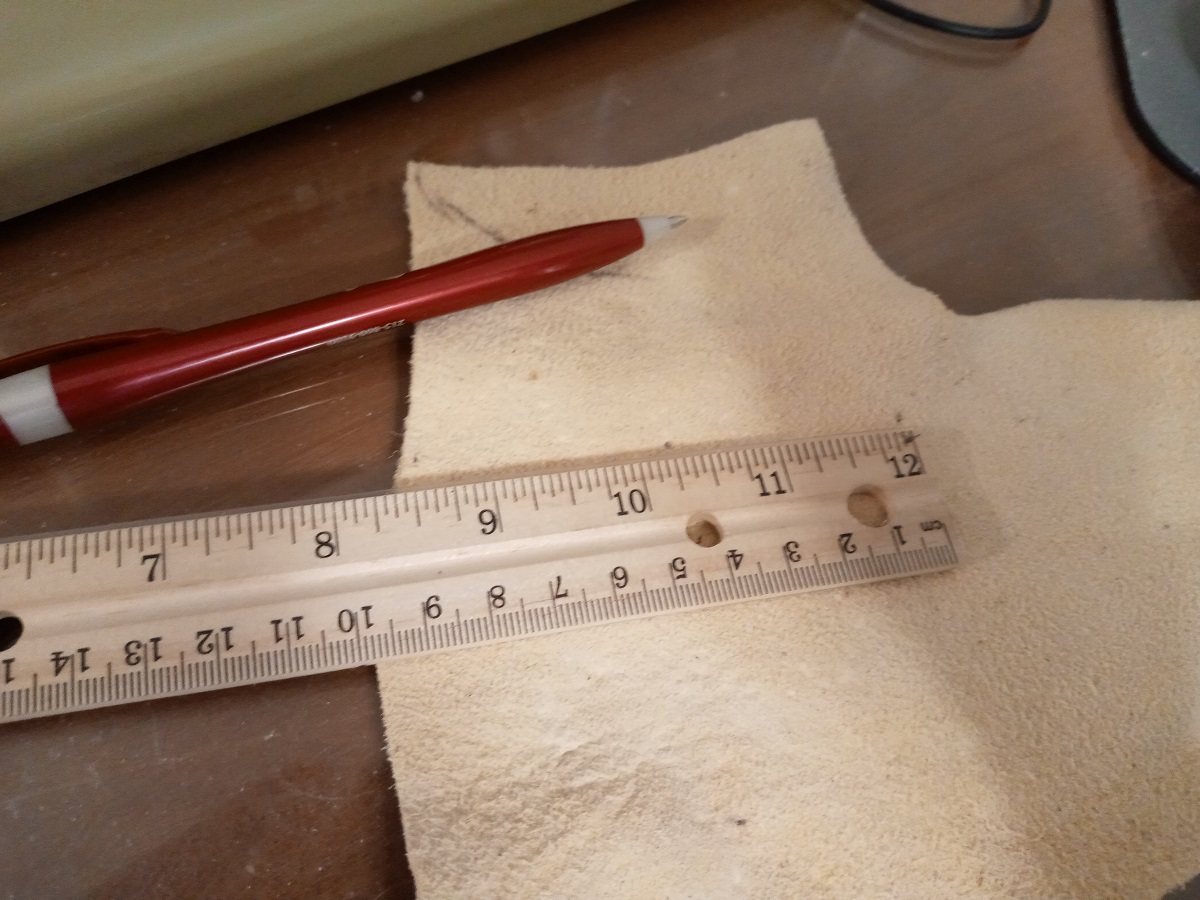


I had instructions prepared about how to find and mark where the bands should be stitched, but with this dark stained wicker, it would be barely if at all visible. That's why the permanent marker you see in the materials layout is going by the wayside. Instead, since the last shield's grip and arm bands fit me well, I just copied the layout from there. For me this wound up with the inner ends of the bands being three inches from the middle and four inches apart, and the outer ends being six inches from the middle and four and a half inches apart. If your arms are of different proportions, then of course you'll need a different fit.


I chose to lace rather than stitch for expediency's sake because this leather is very tough and the wicker is very tight, but I suspect stitching may be more authentic, as peltai in art usually have a line just inside the edge suggesting either stitching or an added rim. I also suspect stitching would keep the facing tighter against the shield.


Pull the twine as tight as possible all around while smoothing the facing onto the back to make sure it's taut. It won't be perfect, and will bag slightly when you hold the shield face-down, but do the best you can.


Tuesday, February 14, 2023
An Achaemenid round shield?
Several years ago, Nadeem at Eran ud Turan shared this ceramic horse and rider from the Pergamon Museum, Berlin, and I've been wondering about it ever since. The rider bears a round shield with a boss — something I have never seen in any other Achaemenid context. I haven't even seen a domed Achaemenid boss outside of antique dealer websites, which I don't put any stock in prima facie since they are usually lacking evidence for how such objects are dated. I've sent a message to the museum asking them for further information; in the meantime, we can only speculate. Domed round shields have been or could be made of wood, leather, rawhide, wicker, and spiraled cane. If the shape of the board is merely an artistic compromise to prevent the ceramic from being too easily broken, but the real thing was flat, then it could also be made from vertical stickwork. None of these possibilities preclude a boss made from a different material.
Sunday, September 4, 2022
Retailer assessment: Baird Brothers
In the runup to Plataea 2022, I found myself in need of several spear handles. Ten years ago, the cheapest way to get one in the U.S. would've been to order a six-foot tool handle. Unfortunately, the mail-order market for these appears to be a mess right now, for many reasons I won't go into. With time running short, I capitulated and ordered from Baird Brothers, a U.S.-based retailer of various wood products. (Their page for wood dowels is listed under Mouldings. Here's a direct link.)
The advantages Baird Brothers offer include a good stock, a wide selection of genera (including favorites like ash and hickory), and a wide selection of sizes - you can order dowels up to 12 feet long, and anything up to eight feet can ship by parcel carrier. They also offer many increments of thickness. On paper, they are perfect for our needs.
There are two drawbacks: First, shipping is rather steep - my order of four ash dowels for spear handles and a smaller one for a javelin totaled just over $60 and cost more than half that much to ship. (On the plus side, delivery to my address in Pennsylvania was pretty quick.) Second, the company will not select for straightness of grain, not even for an additional charge.
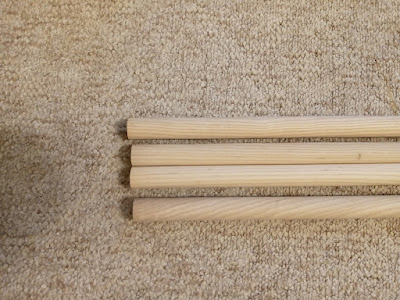 This is the result. The small dowel and three of the large
ones were fine. The last one had extremely diagonal grain in the first and last third. This goes far beyond the usual runout seen in cheap tool
handles. A dowel like this is liable to break
if subjected to stress. For the price, one in five pieces turning out
to be a dud is very disappointing. Luckily I still had the handle I'd
gotten from Torrington to swap out for it.
This is the result. The small dowel and three of the large
ones were fine. The last one had extremely diagonal grain in the first and last third. This goes far beyond the usual runout seen in cheap tool
handles. A dowel like this is liable to break
if subjected to stress. For the price, one in five pieces turning out
to be a dud is very disappointing. Luckily I still had the handle I'd
gotten from Torrington to swap out for it.
Would I recommend Baird Brothers or buy from them again? Probably - but only because I can't seem to find any other choices in the continental U.S. that aren't more inconvenient. You can buy tools and learn to make your own or modify the commonly-sold ash spear handles that are too thick, pay even higher prices for martial arts fighting staves, or take a chance with Baird.
The advantages Baird Brothers offer include a good stock, a wide selection of genera (including favorites like ash and hickory), and a wide selection of sizes - you can order dowels up to 12 feet long, and anything up to eight feet can ship by parcel carrier. They also offer many increments of thickness. On paper, they are perfect for our needs.
There are two drawbacks: First, shipping is rather steep - my order of four ash dowels for spear handles and a smaller one for a javelin totaled just over $60 and cost more than half that much to ship. (On the plus side, delivery to my address in Pennsylvania was pretty quick.) Second, the company will not select for straightness of grain, not even for an additional charge.

Would I recommend Baird Brothers or buy from them again? Probably - but only because I can't seem to find any other choices in the continental U.S. that aren't more inconvenient. You can buy tools and learn to make your own or modify the commonly-sold ash spear handles that are too thick, pay even higher prices for martial arts fighting staves, or take a chance with Baird.
Subscribe to:
Posts (Atom)