The 2,500th anniversary commemoration of the Battle of Plataea will be on July 26-31 next year. That gives just over seven months to prepare, so for anyone who's dawdling about working on their kit (myself included), now's the time to get cracking.
Saturday, December 18, 2021
Plataea 2022 is on

Saturday, October 23, 2021
Dye-fading tests by Elysse Meredith
I stumbled across this article just this morning: The Great 2020 Dyeing Fade Test. It consists of comparisons of lightfastness between different dyes on linen, wool and silk, with illustrations of what the dyed fabrics look like after different periods of sun exposure. By the end of the year, the wools were reduced to drab pastels. Interestingly, the linens all became different hues of off-white - except for linen dyed with indigo, which faded somewhat but was still a nice old denim color by the end.
While I don't expect anyone to take up this suggestion, it would be interesting to see a member of Xerxes' army at Plataia next year wearing clothes dingy, sunbleached and patched after a hard year of campaigning.
Wednesday, August 25, 2021
"Achaemenid objects at Epic Iran" via Eran ud Turan
A special exhibit at the Victoria and Albert Museum in London is ending soon. This collection of images of Achaemenid objects are of particular interest to us. I found the images of the akinakes scabbard throat particularly informative with regard to the thickness-to-width proportions and the fact that it had an additional gold plate with a cutout applied to the top. I expect it will prove helpful to anyone wishing to make a replica of one.
Monday, April 19, 2021
Product review: Two possible belt straps
For almost eight years now, I've been pondering how best to replace the veg-tan weapon belts I wore at Marathon 2011 and 2015. Given my suspicions that the Achaemenids tanned leather with fat or oil, as did Eastern Mediterranean peoples before them, I decided last year that my best option would be a strap of buff leather. This is made from cowhide (perhaps originally water buffalo or European bison hide, thus the name) which is tanned primarily with fish oil in a process similar to German buckskin and American chamois.
An important note: Like "chamois" leather (named for a species of wild European goat but in the U.S. actually made from domesticated sheep), "buff" leather can be a very misleading term. Most items sold as being made from "genuine buff leather" appear to have their top grain intact or are finished such that you can't tell. It makes one wonder what sellers think "buff" means. When I refer to buff leather, what I mean is cowhide tanned with fish oil in a process that gives it a suede surface and a creamy yellow color (also called buff). This kind is rare and hard to obtain nowadays. Most of it in the States goes to the reenactment market, where it's used to make early modern military accoutrements like sword belts.
I've found one person in the U.S. willing to sell unstitched buff by the piece: Roy Najecki of Najecki Reproductions. You can read up on ordering it at his Cartridge Pouch/Box Shoulder Carriage page. Be forewarned that it's not always easy to catch Mr. Najecki on the phone or by e-mail and delivery may take a while, so if you decide to use a buff strap for your belt, order it well ahead of when you need it.
 It looks good, and it's heavy and firm yet flexible. So why wouldn't you decide to use it? Well, in the description above, you'll hopefully notice something that I overlooked: Modern buff leather is tanned not only with oil but also sulfur. This may have something to do with the fact that it smells like burned rubber, and it smells strong. When I first received my strap last fall, I didn't even want to be in the same room with it. I've been storing it in the garage ever since then in hopes that the smell would fade. It has, but it's still very noticeable. Several folks offered suggestions to ameliorate it, such as washing with saddle soap, and I experimented with small bits cut from one end, but nothing appeared to work. I'm still on the fence about wearing it in public unless it's become tamer by the next big event.
It's also not cheap, although because belts are so narrow, the $35 per square foot sticker shock isn't as bad as it sounds unless your belt is going to be enormous. My 1.5x42-inch strap came to $15.31. The next item I'm reviewing here isn't all that much cheaper.
 Chrome-tanned leather such as this Realeather suede belt strap can make a fair substitute for fat-cured leather in appearance and texture. What more is there to add? Well, it doesn't smell, and its texture probably won't be be negatively affected by rain to the extent that a natural tannage would be. The color is a bit darker as you can see, though not as yellowish as lightly-smoked braintan, but the main flaw with this strap is that it's about half the thickness of the buff. Will it support the weight of a fully-loaded bowcase without sagging a lot or ripping? I can't confidently state that it will, unless your bow and its case are a lot smaller and lighter than the ones I use (and the Grozer Old Scythian is already one of the smallest I've seen for sale in its price range).
So there you have it. While either of these will probably look more correct than a veg-tan belt, both have their own major caveats. The search for a perfect solution continues.
An important note: Like "chamois" leather (named for a species of wild European goat but in the U.S. actually made from domesticated sheep), "buff" leather can be a very misleading term. Most items sold as being made from "genuine buff leather" appear to have their top grain intact or are finished such that you can't tell. It makes one wonder what sellers think "buff" means. When I refer to buff leather, what I mean is cowhide tanned with fish oil in a process that gives it a suede surface and a creamy yellow color (also called buff). This kind is rare and hard to obtain nowadays. Most of it in the States goes to the reenactment market, where it's used to make early modern military accoutrements like sword belts.
I've found one person in the U.S. willing to sell unstitched buff by the piece: Roy Najecki of Najecki Reproductions. You can read up on ordering it at his Cartridge Pouch/Box Shoulder Carriage page. Be forewarned that it's not always easy to catch Mr. Najecki on the phone or by e-mail and delivery may take a while, so if you decide to use a buff strap for your belt, order it well ahead of when you need it.

It's also not cheap, although because belts are so narrow, the $35 per square foot sticker shock isn't as bad as it sounds unless your belt is going to be enormous. My 1.5x42-inch strap came to $15.31. The next item I'm reviewing here isn't all that much cheaper.

So there you have it. While either of these will probably look more correct than a veg-tan belt, both have their own major caveats. The search for a perfect solution continues.
Saturday, January 30, 2021
Tablet-woven sash by Aleksandra Zwawiak
Since Giannis Kadoglou alerted us to the idea of tablet weaving several years ago, I've wondered whether the narrow sash worn with Medo-Persian and Elamite dress was made by this method or by cutting and stitching. I had first made some sashes in 2013 from cotton webbing, but the one I wore in 2015 was essentially a double-wide strip cut from wool yardage, sewn into a tube, inverted, and gathered at the ends. This works well enough, but several of us at Amphictyonia have long been of the suspicion that the zigzags shown on the Egyptian statue of Darius the Great were made by tablet-weaving instead.
Over the summer, I gave a shot at tablet-weaving my own belt from hemp. My conclusion? Practice a lot, or leave it to the professionals.
I contacted Aleksandra Zwawiak, proprietor of SagaWeaving (UK), about the possibility of a custom belt three weeks ago after seeing that she had produced belts with apparently the same weave pattern. We discussed the specifications and settled on a design over a couple of days. She ordered the yarn right away and had created the belt within a few days after that, and it arrived at my door this morning. Aleksandra was very pleasant to work with and, having some glimmer of the effort and care this technique requires, I'm impressed at the quality and speed of her work as well, as how modestly-priced it is.
 I requested a solid off-white or beige as might be obtained from a white sheep, and a width of 35-40mm - it comes in at a hair under 40mm. The belt is a bit thick, but it has to be for the weave to be visible, and the wool is very soft and easy to tie. It differs from the Egyptian statue in not having the lengthwise stripes with apparent Holbein stitching. It's my best guess that these represent appliqued trim rather than part of the sash's weave, so I didn't expect or request that they be included.
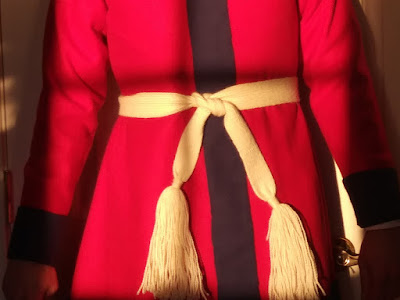 (I seem to be having a bit of trouble with square knots lately.) The standard length of 135cm between the tassels is just about right for my waist (around 30 inches or 76cm); the square knot takes up more length than a simple knot would. The loose ends of the tassels will have to be trimmed almost to nothing, but I haven't yet decided how to eliminate the risk of the knots becoming untied once this is done, so I asked Aleksandra to leave them at full length in the meanwhile. A possible solution would be to immediately soak the trimmed knots in melted rosin-beeswax glue to turn them into solid lumps; this would be permanent and waterproof, though the discoloration might look unsightly.
It must be emphasized that this is a speculative reconstruction. I think it's a highly plausible one, as good as any other, and fits the available evidence.
Over the summer, I gave a shot at tablet-weaving my own belt from hemp. My conclusion? Practice a lot, or leave it to the professionals.
I contacted Aleksandra Zwawiak, proprietor of SagaWeaving (UK), about the possibility of a custom belt three weeks ago after seeing that she had produced belts with apparently the same weave pattern. We discussed the specifications and settled on a design over a couple of days. She ordered the yarn right away and had created the belt within a few days after that, and it arrived at my door this morning. Aleksandra was very pleasant to work with and, having some glimmer of the effort and care this technique requires, I'm impressed at the quality and speed of her work as well, as how modestly-priced it is.


It must be emphasized that this is a speculative reconstruction. I think it's a highly plausible one, as good as any other, and fits the available evidence.
Monday, December 7, 2020
Wooden crescent shield

The front is a goat rawhide drum cover attached with hide glue and stitched with waxed linen cord. I had to spread the glue right up to the edges and weigh them down so they didn't peel away while drying. It's painted with a simple mix of red ochre and boiled linseed oil in the area within the stitching, and commercial white oil paint on the edges. I've found no clearly-attested shield devices from the Persian empire, so after a while spent wondering whether to use a Thracian device or a Persian motif that hasn't been found on shields, I decided to leave it plain.


Sunday, November 8, 2020
Product review: Lord of Battles forged medium spearhead
Spearheads are a dime a dozen on the reenactor market, but it's strangely difficult to find one that's quite right for our time period. The vast majority are either too large, the wrong shape, or very expensive. In fact, India-based manufacturer Lord of Battles' forged medium spearhead is the only one I've found in its price bracket that looks approximately right (though if you have another example, I'd be much obliged if you'd let me know!).
Judging by the finds from Deve Hüyük and elsewhere, the typical Achaemenid spearhead should be relatively small (usually less than a foot long counting the socket) and have narrow kite- or leaf-shaped blades with diamond cross sections, preferably but not always with a mid-rib. I know of only two whose weights are published, at 196g/6.91oz. and 139.2g/4.91oz. They may have weighed more before corrosion, but I would imagine the upper weight should be well under 300 grams or 11 ounces for an average-sized spearhead.
 Lord of Battles' low prices are presumably a result of lower labor costs than in Western countries, loose manufacturing tolerances (i.e. the company will accept more pieces from workshop[s] despite pieces not being exactly what they should be) and rough finish (less labor required in absolute terms). I say all this to explain why I think this spearhead is the way it is.
I bought mine through Kult of Athena, who list it at 11.5 inches overall, blade 6.5 inches, socket about 1 inch on the inside, weight 6.7 ounces. The measurements of the one I received are 11.75 inches overall, blade 7.125 inches, socket 1 inch on the inside, weight almost 11 ounces. The blade also appears to be wider and more sharply tapered. Mine also lacks the advertised rivet hole to help attach it to the spear shaft, and the socket isn't quite circular. Combining all this with fact that one edge is visibly concave and the centerline is curved, I'm left with a poor impression of Lord of Battles' quality control.
The size differences are minor and the asymmetrical appearance might be considered forgivable considering how cheap the spearhead is, but the weight difference (at least for someone like me) is pretty significant. We are talking about something you affix to the end of a 6+ foot handle and wave around in one hand. The edges are pretty thick and the point is squared-off, so thinning and slight re-profiling with an angle grinder or belt sander might noticeably improve it. (In fact, while parts of the spearhead may indeed be forged, I suspect the blade was shaped largely by grinding to begin with. The fact that it has a rough-ground finish doesn't help that impression.) At this price, someone who is set up for that kind of work already might consider it a bargain, and aftermarket finishing would certainly improve its appearance.
Judging by the finds from Deve Hüyük and elsewhere, the typical Achaemenid spearhead should be relatively small (usually less than a foot long counting the socket) and have narrow kite- or leaf-shaped blades with diamond cross sections, preferably but not always with a mid-rib. I know of only two whose weights are published, at 196g/6.91oz. and 139.2g/4.91oz. They may have weighed more before corrosion, but I would imagine the upper weight should be well under 300 grams or 11 ounces for an average-sized spearhead.

I bought mine through Kult of Athena, who list it at 11.5 inches overall, blade 6.5 inches, socket about 1 inch on the inside, weight 6.7 ounces. The measurements of the one I received are 11.75 inches overall, blade 7.125 inches, socket 1 inch on the inside, weight almost 11 ounces. The blade also appears to be wider and more sharply tapered. Mine also lacks the advertised rivet hole to help attach it to the spear shaft, and the socket isn't quite circular. Combining all this with fact that one edge is visibly concave and the centerline is curved, I'm left with a poor impression of Lord of Battles' quality control.
The size differences are minor and the asymmetrical appearance might be considered forgivable considering how cheap the spearhead is, but the weight difference (at least for someone like me) is pretty significant. We are talking about something you affix to the end of a 6+ foot handle and wave around in one hand. The edges are pretty thick and the point is squared-off, so thinning and slight re-profiling with an angle grinder or belt sander might noticeably improve it. (In fact, while parts of the spearhead may indeed be forged, I suspect the blade was shaped largely by grinding to begin with. The fact that it has a rough-ground finish doesn't help that impression.) At this price, someone who is set up for that kind of work already might consider it a bargain, and aftermarket finishing would certainly improve its appearance.
Subscribe to:
Posts (Atom)