For Plataea 2022 I found myself without as many shields as I wanted to bring, so at the last minute I threw one of these together. I don't know that this specific pattern is approved of by any formal reenacting group; it's difficult to document round peltai, although I am assured that they existed, and willow would be a more authentic material. The difference in materials may affect the appearance: This type of coiled weave is most commonly made of rattan because its growth pattern results in very long pieces of even thickness, whereas willow wicker is more often a 90-degree over and under weave, or has the warp sticks radiating outward from the middle. Several pieces of admittedly vague period art suggest the over-and-under weave. The advantage of using a premade round wicker charger is that it's a very quick and easy build.
My forearm measures 14 inches or 35.6cm with my fist closed, so the largest size that this style of platter was made in, around 16 inches/40.6cm, is just barely large enough to make a shield that gives a little bit of overhang. If your forearms are any larger, this project may not be for you.
Materials:
- 16-inch rattan charger for the shield core
I got my first one from Pier 1 Imports several years ago; they no longer carry them, but similar ones can be obtained from other sellers or on eBay. Make sure it is real rattan, since not only are some made from artificial rattan, but many sellers also use a shotgun approach to labeling and add "rattan" to listings for platters that are really made of straw, seagrass, corn husks or other flimsy materials, on the assumption that they're interchangeable for most uses and someone looking for one will be satisfied with another. Additionally, some are made from a mixture of materials, such as rattan coiling held together with seagrass; this is, again, fine if you're just using it as a platter, but not so much for a shield.
- Leather for the facing
The leather should be light- to midweight (about 2-5oz.); it should be soft but have minimal stretch. Rawhide may or may not be the most authentic material (certainly I would prefer it over a planked base), but as a wrapped facing it's tricky to work with. I'm instead using a smoke-colored bison split, which I originally ordered from Crazy Crow for my bowcase last year but which turned out to be on backorder and arrived later — I wouldn't have liked the lack of elasticity for that purpose, but here it seems preferable, as it'll remain more-or-less taut on the shield instead of sagging with time. The piece you use should be at least 18-19 inches (45.7-48.3cm) in every direction and free of holes (or you can patch up any holes).
- Material for the knuckle pad and grip wrap
I'm using German buckskin scraps for this purpose, but I imagine chamois in multiple layers or on top of felt, wool roving, etc. would also work. Soft felt might also be sufficient all on its own.
- Leather bands for the grips
Like the facing, these shouldn't be elastic; you don't want the grips to loosen with use (although I could conceive of various lacing systems to use if they do). The current suede bands sold by Michael's are stiffer than they used to be and just barely adequate; luckily I have some leftover pieces of the older, more pliable kind. You'll need upwards of two feet/61cm.
- Stitching materials
You could probably get by with just a three- or five-ply linen cord, but I'm using several different materials of different thicknesses because I have them on hand and it seems to work better that way. These include buttonweight linen thread for the grip wrap and knuckle pad, three- and five-ply cord for attaching the grips and pad to the shield core, and hemp twine for the facing. The twine should be the soft type. I happened to have some leftover from making my new bowcase which I'd already run over a block of beeswax, making it firmer and less prone to fraying. I do the same with the fil au chinois thread, although it's supposed to be lightly waxed already. Unpaid plug: I very much prefer Crazy Crow linen cord over the kind sold at craft stores; it's much stronger, which is important in this project.
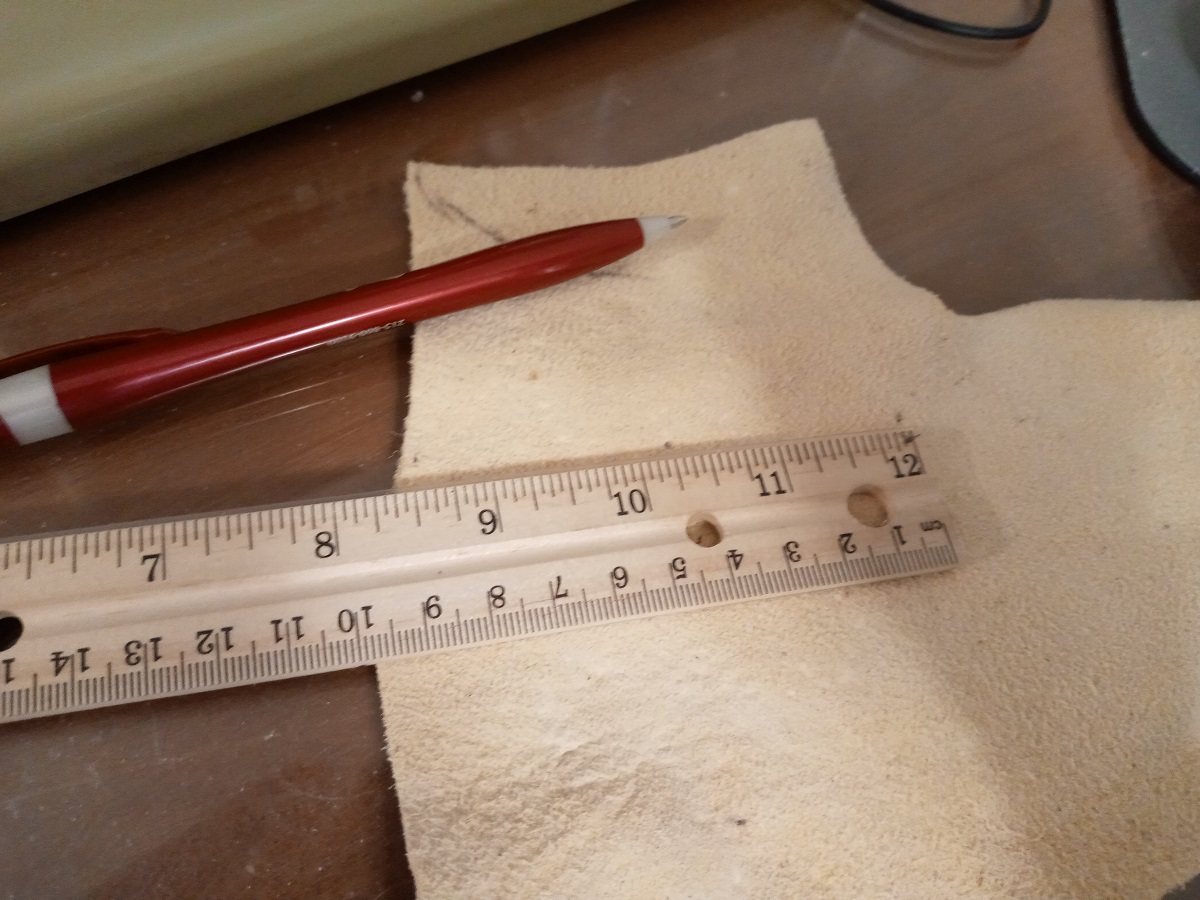
- A heavy sewing needle, large sharp scissors, pliers, an awl, leather punch and pen; also a needle file and a pair of nail scissors. The permanent marker shown here didn't wind up coming into play this time.
A flat shield with no boss cutout will always result in some part of your hand and possibly arm rubbing against the shield's back. In tests I found that the long muscles on the back of the forearm provided a kind of padding on their own (it helps that I normally wear long sleeves), but for the wrist and knuckles, with their bones just below the skin, the chafing was very unpleasant. Therefore a small pad of soft material is helpful. If your skin is sensitive (and especially if you're wearing a short-sleeved or sleeveless tunic) or your forearm is on the bony side, then a longer strip of leather or even a long pad may be necessary.
Since the knuckle pad is attached first, you might as well make it first. I made mine about 5 inches long and 3.5 inches wide across the middle (12.7x8.9cm), slightly tapering in width. There are two outer layers and two smaller inner layers to fill it out, around a quarter inch smaller all around, i.e. half an inch (12.7mm) narrower and shorter.
Only the outer layers need to be stitched; either a running or whip stitch will work.
The pad is stitched to the core by its four corners, with the wide end about an inch from the edge and the small end pointing toward the middle of the shield. On the first corner I used five-ply linen cord, but this was difficult to get through the pad without enlarging the stitch holes. Since the pad is never really subjected to stresses that could result in it being pulled loose, I switched to three-ply cord for the remaining corners.
Getting the needle between the canes without breaking the thin connecting strips is tricky and I frequently had to peer through it at a light bulb to figure out a clear path, poke a pin through to see where the needle should be coming out on the other side, then use pliers to yank the needle through. This is also where the Crazy Crow linen cord shines, as a poorer-quality cord is more likely to fray and break when subjected to this stress (which happened repeatedly when I was making the one I took to Plataea).
The grip is about a 7.5-inch (19cm) suede band with a tube of German buckskin whipstitched around it. I don't have any evidence about how these grips were made, but this design is much more comfortable than a flat leather band with nothing covering it. The stitch holes are all punched ahead of time.
Then the thread spirals through the holes.
When it's time to double back, even if you can't find the exit hole with the needle, the German buckskin is soft enough that as long as you find approximately the right spot, you can punch through with the needle itself.
Finally, knot the thread, then run it over and under the stitches a couple times to keep it safely tucked away.
I had instructions prepared about how to find and mark where the bands should be stitched, but with this dark stained wicker, it would be barely if at all visible. That's why the permanent marker you see in the materials layout is going by the wayside. Instead, since the last shield's grip and arm bands fit me well, I just copied the layout from there. For me this wound up with the inner ends of the bands being three inches from the middle and four inches apart, and the outer ends being six inches from the middle and four and a half inches apart. If your arms are of different proportions, then of course you'll need a different fit.
Check the length of the grip. It should hold your hand firmly against the knuckle pad (so it should be stitched right up against the edges, preventing your hand from sliding down onto the bare wicker) but not pinch your hand uncomfortably.
Because the bands, unlike the knuckle pad, are placed under stress that could bust the stitching, I'm used the full five-ply linen cord to attach them. The holes all had to be enlarged with a needle file. The smallest setting of the leather punch might also work.
Put the facing leather, "wrong" (flesh or stringy/unevenly-finished) side up, on a flat surface and put the shield core on it.
I initially planned on adding an inch and a half to wrap around. I later revised this to one inch, but if you lace the facing on instead of stitching it, a wider margin may be preferable to ensure that the facing can never be peeled off without undoing or cutting the lacing first.
I chose to lace rather than stitch for expediency's sake because this leather is very tough and the wicker is very tight, but I suspect stitching may be more authentic, as peltai in art usually have a line just inside the edge suggesting either stitching or an added rim. I also suspect stitching would keep the facing tighter against the shield.
The margin can be easily marked by first measuring and adding a series of dashes and then connecting them.
Next, mark segments along the circle separated by narrow triangles that point about an inch (2.5cm) toward the middle. I'm antsy and decided to be formulaic about it, but the exact width of the segments and triangles isn't important. In this case I wound up with 40 segments of mostly an inch on the outer edges (except the last couple, which were narrower), separated by triangles of about 3/8 inch wide and 5/8 inch long. This leaves plenty of room for two holes in each tab.
The hemp twine is the thickest stitching material, so I punched small holes with the leather punch rather than the awl (which would require tediously enlarging them with a larger awl or the needle file). The punch doesn't fully remove the plugs of leather; I pushed them out with the needle file and then cut off each one with the nail scissors.
Cut out the triangles. You're now ready for the final step; this is the last chance to decide whether to stitch or lace.
Since I'm lacing, all that needs to be done is run the cord under the middle of each tab and on top of the edges. This will help hold the corners down.
With the twine well-waxed, it can be tightened through multiple holes at once by just pulling on one end, which will cause the tabs to pull up and around the edge of the charger.
Pull the twine as tight as possible all around while smoothing the facing onto the back to make sure it's taut. It won't be perfect, and will bag slightly when you hold the shield face-down, but do the best you can.
Begin to tie the twine while continuing to tighten it. Knot the twine under the tabs for a tidy appearance.
Once everything is as tight as possible, knot the twine a few more times.
The knot's trailing ends can now be tucked under the tabs.
At this point the shield is technically finished. You can paint it however you like or leave it plain. On suede leather, oil paint (with perhaps a little beeswax to keep it from becoming brittle) adheres well enough, though it needs to be rubbed in. It will take a long time to cure, however. The one you see here was painted in the days before Plataea 2022 and required fast-drying acrylic to be ready on time.
The shield weighs next to nothing. Together with its small size and thin grip, it leaves your left arm almost as free as if you weren't carrying one at all. This does come at a cost, though: A shield like this needs to be actively used to intercept and deflect. I think it's safe to say that taking the full shock of repeated heavy blows will break it apart in no time.
A guide to the Achaemenid Persian empire for reenactors, focusing on the Graeco-Persian Wars period. A quick guide to Persian history, society, religion, military, clothing and culture, plus links to reenactment groups and commemorations of the 2,500th anniversary of the Graeco-Persian Wars.
Showing posts with label armor. Show all posts
Tuesday, March 7, 2023
Thursday, October 6, 2016
If you're on Facebook, The Eastern Trader has an album of original Scythian armor. It includes both T&Y-influenced scale as well as "tank top"-style corslets, Kuban, scale and Chalcidian-type helmets, and iron and bronze akinakai, among other objects.
Thanks to Jeroen Zuiderwijk for the link.
Monday, June 27, 2016
Pseudo-wicker shields from Pazyryk
The Pazyryk culture, dating from about the sixth to third centuries BC, is a subgroup of the Scytho-Siberian culture, and its royal kurgans found in the Altai have provided a rich source of artefacts from our time period preserved in permafrost, including rare textile and leather goods.
I recently came across a post by Sean Manning at Book and Sword on small Pazyryk-style shields, including several I'd never seen before. Some of them are made from the familiar stick-and-hide construction, but one is a solid wood shield chiseled to resemble the others at first glance. There's also good shots of the flat leather thong that apparently functioned as a grip.
Monday, May 9, 2016
Linen armor build thread by Todd Feinman
Should've posted this earlier. Todd Feinman is currently working on an Egyptian linen corslet over at the Bronze Age Center. Armors derived from this style may have been worn by Persians (Herodotus I.135) and of course by Egyptians in Achaemenid service; he also proposes that the weaving techniques may be applicable to tube-and-yoke corslets.
Labels:
aigyptos,
armor,
armour,
corselet,
corslet,
cuirass,
linen armor,
linothorax
Monday, July 27, 2015
A bronze shield cover from... ?
I've finally tracked down the Axel Guttmann violin-like shield I mentioned back in 2012. It's not quite the shape of the violin shields seen at Persepolis and is much smaller (only 18 inches/46cm across). Other differences are obvious upon viewing, and running the page through Google Translate I find that a "Prof. P. Schauer, Regensburg" (presumably Peter Schauer) assigns it a Hittite origin. I don't know much about Hittite shields in the Iron Age, but in the late Bronze Age they used shields of a similar shape. FWIW, Matt Amt has suggested that these gave rise to the Dipylon/Boeotian shield of Greece, thus raising the possibility that the Greek and Persian shields derive from a common ancestor.
Tuesday, September 24, 2013
Peoples of the empire: The Scythians
Geographical definition and nomenclature
The term Scythian (O.P. Sakâ, also Gk. Sakai, Lat. Sacae) broadly glosses a number of ancient peoples who shared the culture of the Great Steppe such as it was in Classical antiquity and may have spoken closely-related languages. They were spread over a very wide area:
• The Amyrgian Scythians or Sakâ haumavargâ ("haoma-drinking Scythians") lived in or about modern Uzbekistan. • The Orthocorybantians or Sakâ tigrakhaudâ ("pointed-hat Scythians") were north of Parthia in present Turkmenistan
• The Pausikoi or Apâ Sakâ ("water Scythians") appear to have been somewhat northeast of the Sakâ tigrakhaudâ.
• The Sakâ paradrayâ ("Scythians across the sea") lived north of the Black Sea in the modern Ukraine and part of Romania. They were not part of the Persian empire. These are the folk whom the Greeks referred to simply as Scythians (Skythoi), without qualification.
The Dahae (Dahâ) and Massagetae (*Mâh Sakâ?), who lived in what is now south-central Kazakhstan, are sometimes glossed as Scythian peoples, but for brevity's sake, I won't cover them here. This history will attempt to treat the first four peoples.
Linguist Oswald Szemerényi regarded Skythoi and Sakâ as coming from different roots. The former, he said, derived from an Indo-European root meaning "shoot" and reconstructed in the original Scythian as *Skuda, "archer" (to which he also related the name of Sogdia). In the language of the Sakâ paradrayâ, this became *Skula, accounting for Herodotus' statement that the Royal Scythians (the chief tribe of the Sakâ paradrayâ) called themselves Skolotoi. Szemerényi believed Sakâ came from an Iranian root meaning "roam," and was therefore an exonym given to them by the Persians.
History
There are two popular theories regarding Scythian origins: One states that they branched off from the second-millennium BC Andronovo culture in the area of Central Asia northeast of modern Iran; the other has them develop from the Srubna culture, which occupied the land to the north of and between the Black and Caspian seas during the same period.
A competing - not so much theory as way of assessing the situation - states that the literate Greeks and Persians applied "Skythoi" and "Sakâ" so broadly to distinct Steppe peoples as to make trying to pin down a singular origin for them futile by nature. It is true that Europeans would continue to apply the term "Scythian" to people who came out of the same regions as the Classical Scythians many centuries later, and such indiscriminate use may have already occurred in our period.
Archaeologically speaking, the Scythians we discuss belong to what is called the Scytho-Siberian culture, a very widespread set of material cultural practices (almost certainly shared by completely unrelated peoples) that include such things as a highly equestrian way of life, kurgan tombs, the B-shaped composite bow, the akinakes sword, styles of artwork and so on.
The Scythians along the Black Sea had as their immediate northerly neighbors farming people whom Herodotus lumps with the Scythians; these may be the Chernoles culture, a possibly proto-Slavic archaeological group who appear to have come under Scythian domination. Herodotus devotes much of book IV to the customs of the Black Sea Scythians. He says that they blinded those whom they took as slaves and forced them to churn butter.
The Royal Scythians seem to have enjoyed a period of power in West Asia. Herodotus reports that their king Madyes son of Protothyes defeated Cyaxares in battle (probably in the mid-seventh century) and subjected the Medes for 28 years, plundering many other lands besides, until Cyaxares hosted some of their nobles, got them drunk and, well, things didn't turn out so well for them. They also took part in the coalition that destroyed the Assyrian empire at the end of the century.
According to Herodotus, Darius the Great attempted to conquer the Black Sea Scythians, an event dated to around 512. He crossed the Bosphorus with a pontoon bridge, turned east and found nothing. The Scythians waged a scorched earth campaign, fleeing before his army, destroying pastures and attacking his supply lines. Darius wrote to their king Idanthyrsus a challenge to either fight or submit; Idanthyrsus replied that, as his people were nomads, he had no reason to do either, and only if Darius could find and try to destroy their fathers' kurgans could he expect a pitched battle. With his men exhausted from the endless pursuit, Darius stopped at the Volga River, built some frontier fortresses and then left unsatisfied.
He had long since pacified the Sakâ tigrakhaudâ, who were apparently already subjects at the time of his ascension. In his Behistun inscription, he states that they revolted along with the other provinces, probably around 520-519. They had two chiefs, one of whom was killed and the other, named Skunkha, captured; Darius then appointed a new chief. The pointed-hat Scythians are illustrated at Persepolis bearing clothing and a horse. They are among the few people other than the Persians, Elamites and Medes who are armed, and some writers believe this fact indicates a degree of privilege in the imperial system. Herodotus states that they made up the 10th tax district, together with the Medes and Paricanians, paying 450 talents yearly.
The Pausikoi or Apâ Sakâ enter into Classical history very rarely, but are mentioned as part of the 11th tax district, together with the Caspians, Pantimathi and Daritae, paying 200 talents. They are probably the same people who appear in Hellenistic history as the Apasiakai (Lat. Apasiacae).
Ctesias attributed the conquest of the Amyrgian Scythians to Cyrus. He believed that the Amyrgians were named for their king Amorges. Personally I think the Persian etymology of "haoma-drinking" is more likely, but I'm only an amateur. Ctesias said that Cyrus captured Amorges, whose wife Sparethra waged war and captured several high-ranking Persians. The prisoners were exchanged and the Amyrgians allied with the Persians, fighting alongside them in Lydia. Iranologist Alireza Shahbazi regarded Ctesias' overall narrative as containing so many errors "that it borders on fiction." The name Amorges is not an invention, but it was a Persian name, that of a son of Pissuthnes the satrap of Lydia.
Scythians fought in both the 490 and 480 Persian invasions of Greece. At Marathon, they were posted in the center of the battle line next to the Persians, and were able to withstand the hoplite charge (which was weakest at the center on this occasion). In Xerxes' invasion, the Amyrgians served under the king's half-brother Hystaspes. They fought both on land and as marines, thus were presumably present at Artemision and Salamis, and some were retained by Mardonius to fight at Plataia. Herodotus calls the Scythians the best cavalry in the Persian army at the last battle.
The Black Sea Scythians grew wealthier during the fifth century in large part due to the slave trade from Central Asia to Europe. Around the turn of the fourth century, King Ateas ascended to the throne of the Royal Scythians. During the first half of the century, he centralized royal authority all along the north coast of the Black Sea. In the 340s, he had a snippy diplomatic relationship with Philip of Macedon, which resulted in a battle and Ateas' death at modern Dobruja in 339.
Eastern Scythians fought at the Battle of Gaugamela in 331 as part of Bessus' cavalry. In the same year, Alexander's governor of Thrace or Pontus (sources differ on this), Zopyrion, invaded the kingdom of Scythia for want of something better to do, laid a failed siege to Olbia and was killed while retreating. In 329, an army from Scythia invaded Alexander's empire from the north, but was defeated at the Battle of Jaxartes near modern Tashkent.
The post-Classical history of the Scythian peoples is too complex to cover here. In east and west, Scythian peoples continued on their various ways, but mostly disappeared over the centuries. In the third century BC Scythia collapsed under pressure from Thracians, Celts and Sarmatians. Eastern Scythians settled in Drangiana, creating Sakastan (modern Sīstān) during the early Arsacid period, while others settled in India to create the Indo-Scythian kingdom - all for naught; both have long since disappeared into the native populations.
One last note: The Scythians are often said to have been the inspiration for the Amazons in Greek mythology. This is an oversimplification of things. There is evidence that Amazons were established in Greek myth well before contact with the Scythians. It is true both that many Scythian women have been found buried with weapons and the Greeks have spoken of Scythian female warriors, and that late Archaic and Classical art often shows Amazons in Asiatic clothing. On the other hand, other Greek art shows the Amazons in Greek men's tunics. Herodotus regarded the Amazons and Scythians as separate peoples and believed the Sauromatians were a tribe of mixed Scythian and Amazon ancestry. Most likely, the Greeks during the Archaic concluded that the Amazons were a Steppe people, or used the Scythians as models for later portrayals of their Amazons, because few other peoples in the world had such numbers of female warriors.
Language
The Scythian language or languages are scarcely-attested from a handful of proper names of people and tribes and possibly a seventh-century inscription from Saqqez, Iran, recording what may be a reference to King Protothyes (as "Partitava"), a Scythian who married an Assyrian princess. Most Western scholars regard Scythian as being Eastern Iranian, and part of a Scytho-Sarmatian group which gave rise to the language of the Alans and, in turn, modern Ossetian. The better-attested Eastern Iranian languages of the later kingdoms of Khotan and Tumshuq in what is now western China are thought to be derived from Scythian as well, and are termed "Sakan."
Religion
Scythians were polytheists whom Herodotus says worshipped a seven-member pantheon: Tabiti (whom he regards as the same as the Greek Hestia), Papaios (Zeus), Apia (Gaia), Goitosyros (Apollo), Argimpasa (Uranian Aphrodite), someone whom he calls Heracles, Agin (Ares) and, among the Royal Scythians, Thagimasadas (Poseidon). The vagaries of interpretatio graeca must be kept in mind: It's unlikely that these gods derive from the same sources as those whom Herodotus considers their Greek equivalents.
Tabiti, he says, was most important, but only Agin had temples (of a sort) dedicated to him: In each district, bundles of sticks would be formed into a vast platform three eighths of a mile long and wide, with an akinakes in the middle representing the god himself; new wood was stacked on top as the older wood settled or broke down.
Animal sacrifices, mainly horses, were offered to various gods. Animals were ritually strangled, the meat carved and boiled and part of it then cast on the ground (which reminds me somewhat of the Magian rite). At the temples of Agin, a yearly sacrifice of sheep, goats, horses and enemy prisoners was performed.
The historian also states that a priestly caste of transvestites existed called the Enarei, blessed by Argimpasa to divine the future with strips of linden bark. The name of the Sakâ haumavargâ suggests that they borrowed or retained the ancient Indo-Iranian practice of drinking haoma/soma at religious ceremonies.
Clothing
Most Scythians wore a variant of the cavalry costume, featuring loose-fitting trousers rather than Medo-Persian tights, and a coat held closed by a belt. Most art (with the exception of the Naqš-e Rostam reliefs) shows the coat as overlapping somewhat in the front. At Pazyryk in Siberia, a Scytho-Siberian jacket was found made out of felt rather than woven cloth, and other sites have yielded felt stockings. An abundance of sheep and goat wool, and the relative simplicity of making and working with felt, may have increased its appeal to the Steppe nomads. These nomads, Asiatic Scythians included, also obtained and traded silk on the Silk Road of which they were a part.
The Sakâ tigrakhaudâ wore tiaras with very tall tapering peaks, probably treated felt or leather, or having an internal reinforcement. At Persepolis and Behistun, they otherwise wear Medo-Persian costume, but at Naqš-e Rostam the one present is shown in normal Scythian garb, albeit with a tall hat. Other Scythians wore less spectacular styles of tiara, though they were still usually more pointed than those worn by other peoples.
In most art, Scythians wear low shoes (which I would guess to be similar to Medo-Persian ones), but some pieces from the Black Sea area show pull-on boots that come up to above the ankle.
Weapons
Use of the classic Central Asian recurved composite bow and the attendant gorytos is well-documented. Arrowheads in the same trilobate style as the Persians and Greeks were used, as were leaf-shaped ones with extended sockets; these latter sometimes had a single recurved barb sticking off the socket. Greek and Roman writers said that when going to war, Scythians dipped their arrows in a noxious substance composed of rotting viper corpses, blood and animal dung, the result of which was that even minor wounds would result in simultaneous poisoning and infection.
The Black Sea Scythians' iron swords could be larger than Achaemenid ones, some examples reaching up to two feet overall (almost as big as a Roman gladius) and often featuring loosely-curled antennae or horns on the pommel, though I confess I don't know the time period during which this sub-style evolved. Otherwise, the small akinakes with the T-shaped pommel was common. Swords and knives were still sometimes made of bronze.
Another distinctive Scythian weapon was the sagaris, a small-headed, tomahawk-like battleaxe. The sagaris could be bronze or iron, and had a flared cutting edge, usually a long back spike and a thin straight handle. Scythians also used spears and javelins which were much like those found elsewhere in the ancient world, with socketed, leaf-shaped iron points.
Scythian shields seem to have been commonly made of thin hide (I unfortunately have yet to find analyses of whether rawhide or tanned leather was used) densely woven through with sticks while wet; essentially like smaller versions of Achaemenid shields. Various shapes were known from Pazyryk, and the famous Solokha comb shows one crescent and one which is a sideways rectangle. The crescent seems to have been a very common shape from the Balkans through the Iranian plateau.
Body armor was usually made of scale. Corslets were either of a simple tunic shape or modeled after the Greek tube-and-yoke thorax, and the Scytho-Siberians seem to have pioneered the use of scale neck guards. Shields were also sometimes covered in scale. In the fifth century, pointed leather caps covered with scale began to replace the earlier Kuban-type helmet, which was of solid bronze and fitted close to the head with a low browline (but no nasal guard). Imported Greek helmets (in the Corinthian and derivative styles) also became popular at this time.
The term Scythian (O.P. Sakâ, also Gk. Sakai, Lat. Sacae) broadly glosses a number of ancient peoples who shared the culture of the Great Steppe such as it was in Classical antiquity and may have spoken closely-related languages. They were spread over a very wide area:
• The Amyrgian Scythians or Sakâ haumavargâ ("haoma-drinking Scythians") lived in or about modern Uzbekistan. • The Orthocorybantians or Sakâ tigrakhaudâ ("pointed-hat Scythians") were north of Parthia in present Turkmenistan
• The Pausikoi or Apâ Sakâ ("water Scythians") appear to have been somewhat northeast of the Sakâ tigrakhaudâ.
• The Sakâ paradrayâ ("Scythians across the sea") lived north of the Black Sea in the modern Ukraine and part of Romania. They were not part of the Persian empire. These are the folk whom the Greeks referred to simply as Scythians (Skythoi), without qualification.
The Dahae (Dahâ) and Massagetae (*Mâh Sakâ?), who lived in what is now south-central Kazakhstan, are sometimes glossed as Scythian peoples, but for brevity's sake, I won't cover them here. This history will attempt to treat the first four peoples.
Linguist Oswald Szemerényi regarded Skythoi and Sakâ as coming from different roots. The former, he said, derived from an Indo-European root meaning "shoot" and reconstructed in the original Scythian as *Skuda, "archer" (to which he also related the name of Sogdia). In the language of the Sakâ paradrayâ, this became *Skula, accounting for Herodotus' statement that the Royal Scythians (the chief tribe of the Sakâ paradrayâ) called themselves Skolotoi. Szemerényi believed Sakâ came from an Iranian root meaning "roam," and was therefore an exonym given to them by the Persians.
History
There are two popular theories regarding Scythian origins: One states that they branched off from the second-millennium BC Andronovo culture in the area of Central Asia northeast of modern Iran; the other has them develop from the Srubna culture, which occupied the land to the north of and between the Black and Caspian seas during the same period.
A competing - not so much theory as way of assessing the situation - states that the literate Greeks and Persians applied "Skythoi" and "Sakâ" so broadly to distinct Steppe peoples as to make trying to pin down a singular origin for them futile by nature. It is true that Europeans would continue to apply the term "Scythian" to people who came out of the same regions as the Classical Scythians many centuries later, and such indiscriminate use may have already occurred in our period.
Archaeologically speaking, the Scythians we discuss belong to what is called the Scytho-Siberian culture, a very widespread set of material cultural practices (almost certainly shared by completely unrelated peoples) that include such things as a highly equestrian way of life, kurgan tombs, the B-shaped composite bow, the akinakes sword, styles of artwork and so on.
The Scythians along the Black Sea had as their immediate northerly neighbors farming people whom Herodotus lumps with the Scythians; these may be the Chernoles culture, a possibly proto-Slavic archaeological group who appear to have come under Scythian domination. Herodotus devotes much of book IV to the customs of the Black Sea Scythians. He says that they blinded those whom they took as slaves and forced them to churn butter.
The Royal Scythians seem to have enjoyed a period of power in West Asia. Herodotus reports that their king Madyes son of Protothyes defeated Cyaxares in battle (probably in the mid-seventh century) and subjected the Medes for 28 years, plundering many other lands besides, until Cyaxares hosted some of their nobles, got them drunk and, well, things didn't turn out so well for them. They also took part in the coalition that destroyed the Assyrian empire at the end of the century.
According to Herodotus, Darius the Great attempted to conquer the Black Sea Scythians, an event dated to around 512. He crossed the Bosphorus with a pontoon bridge, turned east and found nothing. The Scythians waged a scorched earth campaign, fleeing before his army, destroying pastures and attacking his supply lines. Darius wrote to their king Idanthyrsus a challenge to either fight or submit; Idanthyrsus replied that, as his people were nomads, he had no reason to do either, and only if Darius could find and try to destroy their fathers' kurgans could he expect a pitched battle. With his men exhausted from the endless pursuit, Darius stopped at the Volga River, built some frontier fortresses and then left unsatisfied.
He had long since pacified the Sakâ tigrakhaudâ, who were apparently already subjects at the time of his ascension. In his Behistun inscription, he states that they revolted along with the other provinces, probably around 520-519. They had two chiefs, one of whom was killed and the other, named Skunkha, captured; Darius then appointed a new chief. The pointed-hat Scythians are illustrated at Persepolis bearing clothing and a horse. They are among the few people other than the Persians, Elamites and Medes who are armed, and some writers believe this fact indicates a degree of privilege in the imperial system. Herodotus states that they made up the 10th tax district, together with the Medes and Paricanians, paying 450 talents yearly.
The Pausikoi or Apâ Sakâ enter into Classical history very rarely, but are mentioned as part of the 11th tax district, together with the Caspians, Pantimathi and Daritae, paying 200 talents. They are probably the same people who appear in Hellenistic history as the Apasiakai (Lat. Apasiacae).
Ctesias attributed the conquest of the Amyrgian Scythians to Cyrus. He believed that the Amyrgians were named for their king Amorges. Personally I think the Persian etymology of "haoma-drinking" is more likely, but I'm only an amateur. Ctesias said that Cyrus captured Amorges, whose wife Sparethra waged war and captured several high-ranking Persians. The prisoners were exchanged and the Amyrgians allied with the Persians, fighting alongside them in Lydia. Iranologist Alireza Shahbazi regarded Ctesias' overall narrative as containing so many errors "that it borders on fiction." The name Amorges is not an invention, but it was a Persian name, that of a son of Pissuthnes the satrap of Lydia.
Scythians fought in both the 490 and 480 Persian invasions of Greece. At Marathon, they were posted in the center of the battle line next to the Persians, and were able to withstand the hoplite charge (which was weakest at the center on this occasion). In Xerxes' invasion, the Amyrgians served under the king's half-brother Hystaspes. They fought both on land and as marines, thus were presumably present at Artemision and Salamis, and some were retained by Mardonius to fight at Plataia. Herodotus calls the Scythians the best cavalry in the Persian army at the last battle.
The Black Sea Scythians grew wealthier during the fifth century in large part due to the slave trade from Central Asia to Europe. Around the turn of the fourth century, King Ateas ascended to the throne of the Royal Scythians. During the first half of the century, he centralized royal authority all along the north coast of the Black Sea. In the 340s, he had a snippy diplomatic relationship with Philip of Macedon, which resulted in a battle and Ateas' death at modern Dobruja in 339.
Eastern Scythians fought at the Battle of Gaugamela in 331 as part of Bessus' cavalry. In the same year, Alexander's governor of Thrace or Pontus (sources differ on this), Zopyrion, invaded the kingdom of Scythia for want of something better to do, laid a failed siege to Olbia and was killed while retreating. In 329, an army from Scythia invaded Alexander's empire from the north, but was defeated at the Battle of Jaxartes near modern Tashkent.
The post-Classical history of the Scythian peoples is too complex to cover here. In east and west, Scythian peoples continued on their various ways, but mostly disappeared over the centuries. In the third century BC Scythia collapsed under pressure from Thracians, Celts and Sarmatians. Eastern Scythians settled in Drangiana, creating Sakastan (modern Sīstān) during the early Arsacid period, while others settled in India to create the Indo-Scythian kingdom - all for naught; both have long since disappeared into the native populations.
One last note: The Scythians are often said to have been the inspiration for the Amazons in Greek mythology. This is an oversimplification of things. There is evidence that Amazons were established in Greek myth well before contact with the Scythians. It is true both that many Scythian women have been found buried with weapons and the Greeks have spoken of Scythian female warriors, and that late Archaic and Classical art often shows Amazons in Asiatic clothing. On the other hand, other Greek art shows the Amazons in Greek men's tunics. Herodotus regarded the Amazons and Scythians as separate peoples and believed the Sauromatians were a tribe of mixed Scythian and Amazon ancestry. Most likely, the Greeks during the Archaic concluded that the Amazons were a Steppe people, or used the Scythians as models for later portrayals of their Amazons, because few other peoples in the world had such numbers of female warriors.
Language
The Scythian language or languages are scarcely-attested from a handful of proper names of people and tribes and possibly a seventh-century inscription from Saqqez, Iran, recording what may be a reference to King Protothyes (as "Partitava"), a Scythian who married an Assyrian princess. Most Western scholars regard Scythian as being Eastern Iranian, and part of a Scytho-Sarmatian group which gave rise to the language of the Alans and, in turn, modern Ossetian. The better-attested Eastern Iranian languages of the later kingdoms of Khotan and Tumshuq in what is now western China are thought to be derived from Scythian as well, and are termed "Sakan."
Religion
Scythians were polytheists whom Herodotus says worshipped a seven-member pantheon: Tabiti (whom he regards as the same as the Greek Hestia), Papaios (Zeus), Apia (Gaia), Goitosyros (Apollo), Argimpasa (Uranian Aphrodite), someone whom he calls Heracles, Agin (Ares) and, among the Royal Scythians, Thagimasadas (Poseidon). The vagaries of interpretatio graeca must be kept in mind: It's unlikely that these gods derive from the same sources as those whom Herodotus considers their Greek equivalents.
Tabiti, he says, was most important, but only Agin had temples (of a sort) dedicated to him: In each district, bundles of sticks would be formed into a vast platform three eighths of a mile long and wide, with an akinakes in the middle representing the god himself; new wood was stacked on top as the older wood settled or broke down.
Animal sacrifices, mainly horses, were offered to various gods. Animals were ritually strangled, the meat carved and boiled and part of it then cast on the ground (which reminds me somewhat of the Magian rite). At the temples of Agin, a yearly sacrifice of sheep, goats, horses and enemy prisoners was performed.
The historian also states that a priestly caste of transvestites existed called the Enarei, blessed by Argimpasa to divine the future with strips of linden bark. The name of the Sakâ haumavargâ suggests that they borrowed or retained the ancient Indo-Iranian practice of drinking haoma/soma at religious ceremonies.
Clothing
Most Scythians wore a variant of the cavalry costume, featuring loose-fitting trousers rather than Medo-Persian tights, and a coat held closed by a belt. Most art (with the exception of the Naqš-e Rostam reliefs) shows the coat as overlapping somewhat in the front. At Pazyryk in Siberia, a Scytho-Siberian jacket was found made out of felt rather than woven cloth, and other sites have yielded felt stockings. An abundance of sheep and goat wool, and the relative simplicity of making and working with felt, may have increased its appeal to the Steppe nomads. These nomads, Asiatic Scythians included, also obtained and traded silk on the Silk Road of which they were a part.
The Sakâ tigrakhaudâ wore tiaras with very tall tapering peaks, probably treated felt or leather, or having an internal reinforcement. At Persepolis and Behistun, they otherwise wear Medo-Persian costume, but at Naqš-e Rostam the one present is shown in normal Scythian garb, albeit with a tall hat. Other Scythians wore less spectacular styles of tiara, though they were still usually more pointed than those worn by other peoples.
In most art, Scythians wear low shoes (which I would guess to be similar to Medo-Persian ones), but some pieces from the Black Sea area show pull-on boots that come up to above the ankle.
Weapons
Use of the classic Central Asian recurved composite bow and the attendant gorytos is well-documented. Arrowheads in the same trilobate style as the Persians and Greeks were used, as were leaf-shaped ones with extended sockets; these latter sometimes had a single recurved barb sticking off the socket. Greek and Roman writers said that when going to war, Scythians dipped their arrows in a noxious substance composed of rotting viper corpses, blood and animal dung, the result of which was that even minor wounds would result in simultaneous poisoning and infection.
The Black Sea Scythians' iron swords could be larger than Achaemenid ones, some examples reaching up to two feet overall (almost as big as a Roman gladius) and often featuring loosely-curled antennae or horns on the pommel, though I confess I don't know the time period during which this sub-style evolved. Otherwise, the small akinakes with the T-shaped pommel was common. Swords and knives were still sometimes made of bronze.
Another distinctive Scythian weapon was the sagaris, a small-headed, tomahawk-like battleaxe. The sagaris could be bronze or iron, and had a flared cutting edge, usually a long back spike and a thin straight handle. Scythians also used spears and javelins which were much like those found elsewhere in the ancient world, with socketed, leaf-shaped iron points.
Scythian shields seem to have been commonly made of thin hide (I unfortunately have yet to find analyses of whether rawhide or tanned leather was used) densely woven through with sticks while wet; essentially like smaller versions of Achaemenid shields. Various shapes were known from Pazyryk, and the famous Solokha comb shows one crescent and one which is a sideways rectangle. The crescent seems to have been a very common shape from the Balkans through the Iranian plateau.
Body armor was usually made of scale. Corslets were either of a simple tunic shape or modeled after the Greek tube-and-yoke thorax, and the Scytho-Siberians seem to have pioneered the use of scale neck guards. Shields were also sometimes covered in scale. In the fifth century, pointed leather caps covered with scale began to replace the earlier Kuban-type helmet, which was of solid bronze and fitted close to the head with a low browline (but no nasal guard). Imported Greek helmets (in the Corinthian and derivative styles) also became popular at this time.
Labels:
amorges,
armor,
ateas,
clothes,
clothing,
corselet,
corslet,
headwear,
helmet,
history,
idanthyrsus,
peoples of the empire,
sacae,
saka,
sakai,
scythia,
scythian costume,
scythians,
weapons
Friday, May 25, 2012
Shield yourself from this
Update 12/10/13: This post contains information that is probably incorrect. Please see here.
The Achaemenids knew of four or five styles of shields: round or oval (possibly), violin-shaped, rectangular, crescent and the Greek Argive shield. Of these, only the rectangular style is attested as having been used in the Graeco-Persian wars period. In addition, some illustrations have been found of imperial troops (the Negro Alabastrons) and Persian hunters with cloaks draped over their left arms presumably as makeshift protection.
The only attested material for Persian shields is called by the Greeks gerrha ("wicker"). While to my knowledge no Achaemenid shields have been found, four shields dating to the Sassanid dynasty were found in the 1922-37 excavations at the Hellenstic (later Roman) city of Dura-Europos in Syria, and their construction could offer a model for that of earlier shields. They were not technically wicker, but consist of wood dowels (sometimes incorrectly referred to as reeds) woven vertically through a single sheet of soaked rawhide. The rawhide was folded over the ends of the sticks and sewn between them. One or two horizontal sticks were attached to the back, preventing the shield from rolling up as the rawhide dried, and the grip appears to have been a wooden rod tied to the back.
These shields were unpainted. The holes through which the sticks were threaded form chevrons down the shields' faces. There is a Greek vase showing a Persian soldier with a rectangular shield bearing an elongated checker pattern which could have been produced the same way.
Round or oval
An enigmatic, slightly elongated shield appears in at least one scene in the reliefs at Persepolis (middle, second from top). It's roughly the same size and shape as the violin. Its face is smooth, showing no evidence of wickerwork, boss or rim (though the violin shields in the same scene also lack rims, which they have elsewhere). If it's a representation of the Argive shield (and that's a big if), it would indicate that the Persians adopted this type far earlier than my research otherwise suggests. I suppose it's even possible that they are violin shields to which the artists for some reason didn't add the cutouts or bosses, but that seems very unlikely to me.
Violin
This double-gripped style is known, as far as I know, almost entirely from Persepolis. It had a rim (even around the cutouts, which were located halfway or slightly more than halfway down from the top of the shield) and had a round boss right in the middle with four round dimples or cutouts. It's shown with a smooth face and inside, unlike the rectangular shield (also shown at Persepolis, with its stickwork construction clearly visible), so it may have been made of wood planks and/or had a facing and lining of metal, leather or fabric. (In fact, a solid bronze shield facing of similar shape is or was held in the Axel Guttmann collection, although I can't find out much about it.) A bronze boss from one was found on the island of Samos off the coast of Turkey (close, in fact, to Mount Mycale). However, I've never seen it in battle art and never in Greek art of any kind. This at least suggests that it wasn't very typical of Persian arms in the war.
I can think of several reasons for this disconnect. The violin shield may have been relegated to parade wear, perhaps an artifact of a previous generation of soldiers, or it may have been inherited as an item of ceremony from an older culture, perhaps the Elamites. It may have still been in use, but not nearly common enough for the Greeks to think of it as "the" Persian shield. Search as I might, I can't find anything to back up any of these speculations.
Some people call this style the Dipylon or Boeotian shield, after similar types seen in Greek art. But I feel this is incorrect. These are Greek types, with significant differences in details: Persian shields had large bosses and cutouts that are almost full circles, while the Greek ones had no bosses and their cutouts were more semicircular. One may be copied from the other via intermediaries or they may derive from the same prehistoric source, but they could just as likely be totally unrelated.
Rectangular
Being perhaps up to five feet high, the rectangular shield was a kind of pavise which could be propped up to stand on its own and (according to Herodotus) attached to others to form a wall. Of course, against the press of a Greek phalanx, this structure couldn't stand up very long, but it likely served very well against showers of arrows, and would be useable in one-on-one spear combat.
From what I've seen, this type appears to be the most common Persian shield attested in Greek art. There's at least one picture of one at Persepolis as well. An RAT member once uploaded a photo of it, which has since been lost, but you can see a line drawing at Mark Drury's site.
This type of shield is usually referred to as a spara. This word comes from a glossary of Hesychius of Alexandria, who roughly a millennium later defined sparabarai as gerrhophoroi ("wicker-bearers"). While -bara meant "bearer" (and comes from the same PIE root as -bearer and -phoros), the Middle Persian word spar and its Modern Persian derivative sipar mean "shield," so it's possible that *spara also simply meant a shield of any kind. If, as I suspect, all types of Persian shields were what the Greeks would call wicker, then "wicker-bearer" doesn't indicate what type of shield a soldier bore. I suppose the reverse might also be true: that *spara did refer to a particular type of shield, but by Middle Persian had become more generic.
Crescent
Showing up in Greek art late in the 5th century, the crescent shield resembled the Thracian pelte and some Scythian shields. It could be single- or double-gripped and was somewhat smaller than an Argive shield (which is roughly two-and-a-half to three feet in width).
The Hoplite Association has reproduced crescent shields using 3mm (about eight-ounce) vegetable-tanned leather and wooden dowels; the edging is the same leather, laced on. Andy Cropper used two grip systems: one to be held in the hand and the other to be strapped to the arm, allowing archers to hold it while shooting.
In modern literature, this shield in Persian context is called a taka and its bearers takabara, but in fact we have no reason to think the ancients called them that. The word takabara comes from the Persian phrase Yauna Takabara ("taka-bearing Ionians"), found at Persepolis and generally thought to be a reference to the Macedonians (Yauna or "Ionian" being the generic Persian word for Greeks). Many researchers think that taka here refers to the petasos, or Greek sun hat, which was round and dished and shaped pretty much like a shield. The phrase is translated into Akkadian as "who bear shields on their heads." Nicholas Sekunda in Achaemenid Military Terminology states that taka means "hide," and should by extension be taken to mean a leather shield. It is, however, difficult to be certain, and of course the petasos isn't crescent-shaped.
Argive
One of the main tools of the Greek hoplite, eminently suited for phalanx combat. Putting aside the possibility that the round Perspolis shields are of this type, so far as I know Persians are only attested as using them in the 4th century, and then only rarely. Since a great deal of literature on the construction and use of the Argive shield is available elsewhere, I shall refrain from going into it here.
Next up: You'll need a few other things.
The Achaemenids knew of four or five styles of shields: round or oval (possibly), violin-shaped, rectangular, crescent and the Greek Argive shield. Of these, only the rectangular style is attested as having been used in the Graeco-Persian wars period. In addition, some illustrations have been found of imperial troops (the Negro Alabastrons) and Persian hunters with cloaks draped over their left arms presumably as makeshift protection.
The only attested material for Persian shields is called by the Greeks gerrha ("wicker"). While to my knowledge no Achaemenid shields have been found, four shields dating to the Sassanid dynasty were found in the 1922-37 excavations at the Hellenstic (later Roman) city of Dura-Europos in Syria, and their construction could offer a model for that of earlier shields. They were not technically wicker, but consist of wood dowels (sometimes incorrectly referred to as reeds) woven vertically through a single sheet of soaked rawhide. The rawhide was folded over the ends of the sticks and sewn between them. One or two horizontal sticks were attached to the back, preventing the shield from rolling up as the rawhide dried, and the grip appears to have been a wooden rod tied to the back.
These shields were unpainted. The holes through which the sticks were threaded form chevrons down the shields' faces. There is a Greek vase showing a Persian soldier with a rectangular shield bearing an elongated checker pattern which could have been produced the same way.
Round or oval
An enigmatic, slightly elongated shield appears in at least one scene in the reliefs at Persepolis (middle, second from top). It's roughly the same size and shape as the violin. Its face is smooth, showing no evidence of wickerwork, boss or rim (though the violin shields in the same scene also lack rims, which they have elsewhere). If it's a representation of the Argive shield (and that's a big if), it would indicate that the Persians adopted this type far earlier than my research otherwise suggests. I suppose it's even possible that they are violin shields to which the artists for some reason didn't add the cutouts or bosses, but that seems very unlikely to me.
Violin
This double-gripped style is known, as far as I know, almost entirely from Persepolis. It had a rim (even around the cutouts, which were located halfway or slightly more than halfway down from the top of the shield) and had a round boss right in the middle with four round dimples or cutouts. It's shown with a smooth face and inside, unlike the rectangular shield (also shown at Persepolis, with its stickwork construction clearly visible), so it may have been made of wood planks and/or had a facing and lining of metal, leather or fabric. (In fact, a solid bronze shield facing of similar shape is or was held in the Axel Guttmann collection, although I can't find out much about it.) A bronze boss from one was found on the island of Samos off the coast of Turkey (close, in fact, to Mount Mycale). However, I've never seen it in battle art and never in Greek art of any kind. This at least suggests that it wasn't very typical of Persian arms in the war.
I can think of several reasons for this disconnect. The violin shield may have been relegated to parade wear, perhaps an artifact of a previous generation of soldiers, or it may have been inherited as an item of ceremony from an older culture, perhaps the Elamites. It may have still been in use, but not nearly common enough for the Greeks to think of it as "the" Persian shield. Search as I might, I can't find anything to back up any of these speculations.
Some people call this style the Dipylon or Boeotian shield, after similar types seen in Greek art. But I feel this is incorrect. These are Greek types, with significant differences in details: Persian shields had large bosses and cutouts that are almost full circles, while the Greek ones had no bosses and their cutouts were more semicircular. One may be copied from the other via intermediaries or they may derive from the same prehistoric source, but they could just as likely be totally unrelated.
Rectangular
Being perhaps up to five feet high, the rectangular shield was a kind of pavise which could be propped up to stand on its own and (according to Herodotus) attached to others to form a wall. Of course, against the press of a Greek phalanx, this structure couldn't stand up very long, but it likely served very well against showers of arrows, and would be useable in one-on-one spear combat.
From what I've seen, this type appears to be the most common Persian shield attested in Greek art. There's at least one picture of one at Persepolis as well. An RAT member once uploaded a photo of it, which has since been lost, but you can see a line drawing at Mark Drury's site.
This type of shield is usually referred to as a spara. This word comes from a glossary of Hesychius of Alexandria, who roughly a millennium later defined sparabarai as gerrhophoroi ("wicker-bearers"). While -bara meant "bearer" (and comes from the same PIE root as -bearer and -phoros), the Middle Persian word spar and its Modern Persian derivative sipar mean "shield," so it's possible that *spara also simply meant a shield of any kind. If, as I suspect, all types of Persian shields were what the Greeks would call wicker, then "wicker-bearer" doesn't indicate what type of shield a soldier bore. I suppose the reverse might also be true: that *spara did refer to a particular type of shield, but by Middle Persian had become more generic.
Crescent
Showing up in Greek art late in the 5th century, the crescent shield resembled the Thracian pelte and some Scythian shields. It could be single- or double-gripped and was somewhat smaller than an Argive shield (which is roughly two-and-a-half to three feet in width).
The Hoplite Association has reproduced crescent shields using 3mm (about eight-ounce) vegetable-tanned leather and wooden dowels; the edging is the same leather, laced on. Andy Cropper used two grip systems: one to be held in the hand and the other to be strapped to the arm, allowing archers to hold it while shooting.
In modern literature, this shield in Persian context is called a taka and its bearers takabara, but in fact we have no reason to think the ancients called them that. The word takabara comes from the Persian phrase Yauna Takabara ("taka-bearing Ionians"), found at Persepolis and generally thought to be a reference to the Macedonians (Yauna or "Ionian" being the generic Persian word for Greeks). Many researchers think that taka here refers to the petasos, or Greek sun hat, which was round and dished and shaped pretty much like a shield. The phrase is translated into Akkadian as "who bear shields on their heads." Nicholas Sekunda in Achaemenid Military Terminology states that taka means "hide," and should by extension be taken to mean a leather shield. It is, however, difficult to be certain, and of course the petasos isn't crescent-shaped.
Argive
One of the main tools of the Greek hoplite, eminently suited for phalanx combat. Putting aside the possibility that the round Perspolis shields are of this type, so far as I know Persians are only attested as using them in the 4th century, and then only rarely. Since a great deal of literature on the construction and use of the Argive shield is available elsewhere, I shall refrain from going into it here.
Next up: You'll need a few other things.
Labels:
achaemenid,
argive shield,
argolic shield,
armor,
armour,
aspis,
hoplon,
shield,
spara,
sparabara,
sparabarai,
taka,
takabara,
weapons
Tuesday, May 22, 2012
Armored bruiser
It's generally agreed that the Persian army wasn't very well-armored overall. However, two types of body armor are known to have been used.
Scaly
The older type is a scale corslet of the same general sort used in West Asia for centuries. According to archaeological finds, Persian scale was mostly iron and sometimes bronze. Xenophon describes Persian cavalry wearing bronze thorakes, but doesn't explicitly describe them as scale. A cavalry commander named Masistius is reported to have worn golden scale (presumably gilded iron, which would be protective but resist rust) under his tunic (Herodotus IX.22). If wearing scale under the tunic was standard practice, perhaps to keep the sun off the metal, that could account for the lack of scale portrayed in period art, even among the presumably elite guards of the king in imperial reliefs.
If earlier Mesopotamian art is any indication, it's likely the Persian corslet had short or no sleeves. Anyone looking to replicate one might look to the work done by Sean Manning. It is a massive undertaking.
T&Y!
The Persians and Scythians also sometimes used Greek-style corslets. The type has been widely known as the linothorax ("linen chest"), which is actually a term from Homer, though references to thorakes of linen exist in Classical literature. In fact there is no clear evidence linking the style of corslet to linen construction, and a competing theory has emerged linking the style to the term spolas, indicating hide (probably leather) construction.
Some long (but worthwhile!) threads at RAT have examined the literary and artistic evidence, cost and protective qualities of quilted linen, glued linen and leather in the style. One outcome of the discussions is that the style is increasingly referred to as a "tube-and-yoke" or T&Y corslet/cuirass, since the fact that it was made out of a tube around the body and yoke over the shoulders is the only thing that can be said for certain about it.
As for what it all means for us: To be honest, I haven't done enough research on the experiments many reenactors have performed to recommend what the new XMFM member should use if you choose to wear a T&Y. The tentative rule will be that you may use any material that could plausibly have existed in the period and demonstrably provides decent protective qualities. (That is, if your corslet is no more going to save you from a spear thrust than a motorcycle jacket would, you need to go back to the drawing board.) Keep in mind that the two options aren't mutually exclusive: It's not impossible, given what we know, for some T&Ys to have been linen and others leather.
After the Graeco-Persian wars, the T&Y was sometimes reinforced with scale, usually around the midsection.
Upon the head
Scaly
The older type is a scale corslet of the same general sort used in West Asia for centuries. According to archaeological finds, Persian scale was mostly iron and sometimes bronze. Xenophon describes Persian cavalry wearing bronze thorakes, but doesn't explicitly describe them as scale. A cavalry commander named Masistius is reported to have worn golden scale (presumably gilded iron, which would be protective but resist rust) under his tunic (Herodotus IX.22). If wearing scale under the tunic was standard practice, perhaps to keep the sun off the metal, that could account for the lack of scale portrayed in period art, even among the presumably elite guards of the king in imperial reliefs.
If earlier Mesopotamian art is any indication, it's likely the Persian corslet had short or no sleeves. Anyone looking to replicate one might look to the work done by Sean Manning. It is a massive undertaking.
T&Y!
The Persians and Scythians also sometimes used Greek-style corslets. The type has been widely known as the linothorax ("linen chest"), which is actually a term from Homer, though references to thorakes of linen exist in Classical literature. In fact there is no clear evidence linking the style of corslet to linen construction, and a competing theory has emerged linking the style to the term spolas, indicating hide (probably leather) construction.
Some long (but worthwhile!) threads at RAT have examined the literary and artistic evidence, cost and protective qualities of quilted linen, glued linen and leather in the style. One outcome of the discussions is that the style is increasingly referred to as a "tube-and-yoke" or T&Y corslet/cuirass, since the fact that it was made out of a tube around the body and yoke over the shoulders is the only thing that can be said for certain about it.
As for what it all means for us: To be honest, I haven't done enough research on the experiments many reenactors have performed to recommend what the new XMFM member should use if you choose to wear a T&Y. The tentative rule will be that you may use any material that could plausibly have existed in the period and demonstrably provides decent protective qualities. (That is, if your corslet is no more going to save you from a spear thrust than a motorcycle jacket would, you need to go back to the drawing board.) Keep in mind that the two options aren't mutually exclusive: It's not impossible, given what we know, for some T&Ys to have been linen and others leather.
After the Graeco-Persian wars, the T&Y was sometimes reinforced with scale, usually around the midsection.
Upon the head
Xenophon states in the Anabasis and the Cyropaedia that the king's cavalry wore helmets, though Persians generally didn't. A bronze helmet found at Olympia was inscribed with a claim that it had been captured from the "Medes" and is believed to be a trophy from Marathon; it's an old Near Eastern onion shape.
Others have ventured that Persians wore helmets of the Kuban type, more commonly associated with the Scythians; these are low-profile bronze caps, dipping low between the eyes and with a straight, rather high cut from the sides around the back, to which some sort of aventail may have been attached. The low shape could conceivably allow it to be completely hidden under a tiara.
An interesting but under-publicized find is an iron helmet from Achaemenid Sardis. Its segmented construction and large cheek guards bear a startling resemblance to those of spangenhelmen of centuries later.
Next time: If I am not shield...
Labels:
achaemenid,
armor,
armour,
corselet,
corslet,
cuirass,
helmet,
linothorax,
scale,
thorax,
tube and yoke
Subscribe to:
Posts (Atom)


