I recently came across James White's 2019 dissertation for UC Santa Barbara at eScholarship. It is, as the name indicates, an overview of what's known and indicated from archaeological, artistic and literary sources about Achaemenid bows and spears. I haven't read the whole thing yet, but it appears to be very informative; at the very least it's a good index of sources.
Showing posts with label bow. Show all posts
Showing posts with label bow. Show all posts
Friday, August 25, 2023
"Bows and Spears in Achaemenid Persia" by James White

Wednesday, August 3, 2022
Various practical addenda from Plataea 2022
Well, Plataea 2022 ended on Saturday and although there's a lot to be said, I'm limiting myself to some observations to bear in mind about all the stuff I brought out there:
- A four-inch-wide (internal), eight-foot-long PVC pipe with caps held on by duct tape makes a very protective package for spears, but it's so heavy and awkward (particularly when you already have two suitcases and a rifle case with your bows and arrows in it), and expensive to ship, that I wound up leaving both it and all my spears spears with other reenactors who felt they'd have a use for them and less difficulty/expense transporting them. I will not travel with spears in the future. If I send any more to Greece, I'll send them well ahead of time by the cheapest service available and leave them with a trusted friend.
- Under the (to my Pennsylvanian standards) quite aggressive heat and sun, the film of linseed oil-beeswax sealer I applied on top of the oil paint on my crescent shield softened and rubbed off. Specifically, the area on top of the dark red ochre-painted part of the shield; the area on top of the white edge was somewhat more resistant (presumably because the film is transparent and the dark paint heated up in the sun faster). The same mixture used as a paint binder on my new gorytos was also more resistant, but did soften after prolonged exposure, allowing thicker bits to be scraped off. The rosin-beeswax glue attaching the leather facing of my new akinakes scabbard also softened. By contrast, anything treated, bound or sealed with only linseed oil or rosin (the ochre paint on the shield, the spear handles, and the sinew wrappings of my arrows) were all fine. So basically anything containing beeswax was in danger of melting.
- The buff leather weapon belt performed admirably. The chrome-tanned belt sagged and became uncomfortable. I'm not sure whether this is because the holes I punched in the buff belt allowed it to be laced tighter or because it's a thicker leather, but I suspect both. The belt being nice and snug was definitely helpful.
- As I suspected, the smaller bow and commensurately smaller gorytos and arrows were much easier to carry. The search for an accurately Classical-styled bow of less than 36 inches strung continues.
- The 1/2-inch-thick wooden crescent shield is at least as heavy as larger wicker ones in the same style. This, too, needs improvement. I also threw together a round wicker mat with pelta-style grips and a suede facing, which at 16 inches in diameter (about the size of the smallest Scottish targes, and barely large enough to cover my arm from elbow to knuckles with fingers closed around the handgrip) is so light I barely notice I'm wearing it, but I'd have felt much, much better about it if it were crescent-shaped.
- A 12-ounce ceramic bottle, while convenient to carry, is only around a quarter as much water as I need to drink over the course of a Greek midsummer day in the field. Also, water left out becomes as hot as the surrounding air in just a few hours. What I wound up doing was to take a two-liter plastic bottle of water and keep it overnight in the hotel minifridge where it half-froze, wrapped it in spare clothing and kept it in my tent in my suitcase. That way I could still at least refill my ceramic bottle with slightly cool water by the end of the day. A proper cooler with ice blocks would've been better.
- Food must be kept elevated or it will be invaded by ants. A table of some kind, a crate, a box, anything will help.
Wednesday, June 29, 2022
Pieced gorytos, part V and last


Sunday, May 29, 2022
Pieced gorytos, part IV
It took much longer for the paint to cure than I expected, as the slight grooves between the plywood face and veneer edge held accumulations that were thicker and took longer to oxidize. Once this was done, I tried to attach the leather to the spine with pitch glue. However, I was reluctant to keep the pitch glue melted with the heat gun for fear it would make the veneer edging delaminate. All this could be avoided if I could figure out how to make a solid wood spine, but in the end, I peeled off the pitch glue, reattached the leather with rubber cement and finally started drilling a few days ago.
 The stitching is soft hemp twine from a craft store, which I drew back and forth over a block of beeswax to lubricate it and reduce fraying. I'm not sure exactly how much I used, but I spooled out about 24 feet more than necessary, which does make the stitching process tedious.
I spaced the stitch holes half an inch apart and marked them with a pen on the leather, then ran the gorytos under the drill press. The size of the drill bit is dependent on the thickness of the twine. In this case, a 3/32" bit was just right. I could lace the first running stitch by hand with care. After drilling, I scrubbed the sawdust off with a stiff nail brush.
 When doubling the running stitch, I had to flatten the end of the twine and put it on a needle. As the stitch hole was now crowded with the first stitch, I occasionally had to draw the needle through with a pair of pliers, but this became less often necessary as my fingers got sticky with beeswax.
After completing the stitching, I tied the twine off a bunch of times and cut it with about two inches of excess.
 The fit is a little more snug than I'd like; I think the string and tip of the bow should not rub against the spine at all, so an extra inch of leather would've been a good idea. This leather will stretch with time, but whether it will stretch enough is another question.
Anyway, the next step will be to make the belt attachments and then the cover.

I spaced the stitch holes half an inch apart and marked them with a pen on the leather, then ran the gorytos under the drill press. The size of the drill bit is dependent on the thickness of the twine. In this case, a 3/32" bit was just right. I could lace the first running stitch by hand with care. After drilling, I scrubbed the sawdust off with a stiff nail brush.

After completing the stitching, I tied the twine off a bunch of times and cut it with about two inches of excess.

Anyway, the next step will be to make the belt attachments and then the cover.
Tuesday, April 26, 2022
Pieced gorytos, part III
I wanted to make the spine from solid wood, but was still concerned with it snapping across the curved part. Historically, there may have been several solutions to this problem: The spines may have been very thick and heavy, made of naturally curved branches, boiled or steamed and then bent, made in two crossgrain plies and glued like the one I made in 2015 (which nonetheless did snap when I fell on it), sheathed in metal to reinforce them, actually made of metal, or just treated with great care and/or replaced as soon as they did break. I have no evidence for any of these methods.
 In any case, what I wound up doing was cutting the spine from plywood. This is, of course, the only method I can say for certain is not historical, but seemed to me the only one feasible at the moment. I cut it on a scroll saw and smoothed the edges on my mini-belt sander. Unfortunately, the edges are very clearly plywood and provide an easy entry point for water and grime, so my next step was to apply veneer edging intended for just this purpose. This is a paper-thin continuous strip of wood with a hot glue backing, which is melted with a clothing iron, heat gun or other source of heat and pressed into place.
 I edged the exterior and the interior, which will be rubbing against the bow. The half-inch veneer edging turned out to be slightly wider than the half-inch plywood is thick, so I next had to trim off the overhang.
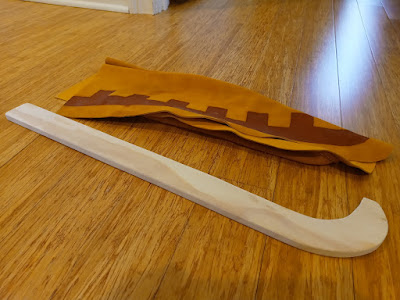 After that, I sanded the spine to 320 grit, rounding off all the sharp corners as I went. This having been done, I still found its appearance unconvincing somehow. On close inspection, it simply does not look like solid wood.
 Ultimately what I've done is covered the whole thing with simple ochre oil paint (except the inner edge, to prevent it from rubbing off on the bow). This not only masks the grain, but also fills in splintered flaws in the wood and provides some sealing against moisture. The paint I mixed up was a little thick. If it turns out to begin crumbling off the surface too easily when cured, I'll rub it down with a little extra oil and/or wax. Otherwise, it should be roughly another week before I can stitch the main pocket on.


Monday, February 7, 2022
Pieced gorytos, part II
After about a week and a half, the paint was completely cured. I moved onto the next step, stitching the arrow pocket.

 Instead of glue, I kept the arrow pocket in place this time with staples. This is a bit destructive, but easier than using a period glue, and ancient people could easily have achieved the same thing with pins.
 The pocket is attached to the back with 40-weight waxed linen thread using a simple double running stitch and pulling out the staples as I went. Its long edges are brought together slightly to give the pocket the fullness needed to accommodate arrows, particularly the large, blunt rubber arrowheads we use during combat reenactment. This means some ugly crimping on the short edge. I tried to distribute the slack evenly during the stapling process, but it wound up a little uneven.
 The lower edges of the body panels are carefully lined up and stapled first at both ends, then in the middle, then equidistant between these three and so on. I wound up using nine staples in this manner; given the length of the edge, they seemed to be the right distance apart. Note that some of the linseed oil seems to have soaked into the leather. Time will tell if this is going to be a problem. The paint doesn't scratch or rub off easily, so I think the paint itself will hold. Whether the oil will have a negative effect on the leather is another question.
 I'd meant to stitch the lower edge completely flat, but it seemed to develop slack as I moved from the upper end to the lower and I wound up puckering the seam a bit to shorten it (pulling the thread diagonally downward from the seam a little to pull the stitches closer together). This appeared to work.

 On the whole, I'm satisfied with how this project has gone so far. The next step (creating a curved spine that won't break too easily) is going to be a major challenge.
Thursday, January 20, 2022
Pieced gorytos, part I
Since Marathon 2015, I've wanted a bowcase that isn't nearly as big as I am for the running around and shooting part of reenactments. This requires a smaller bow, of course, but a bowcase that fits more closely to the bow's outline will present less area when viewed from the side. In fact, the Scythian/Persian gorytos in Greek art does tend to have an outline on the lower edge that follows the curve and reflex of the strung bow staff closer than could be achieved without either building the gorytos too tight and stretching the leather or having a seam. This suggests that the main pocket is made in two parts. A construction method like this would also allow the bowcase to be made from smaller hides or hides with flaws that mean they have to be cut into smaller contiguous pieces.
 The bow I'm using as a model is Ali Bow's Mini Han; not quite right for our period with its wooden siyahs, but at just under 34 inches/86cm strung, it's the smallest recurve I can find that still looks like a bow and not a toy. I may eventually replace it if a truly tiny Scythian-style bow becomes available, but I have been warned that resin bows may crack with repeated use, so I'm going with the all-fiberglass Ali for the time being.
The hide is Crazy Crow's AA Grade Gold Buckskin. It's grain-on, but the flesh side has a short, even nap similar to wet-scrape leather that can be the outside. The color, gaudy though it may look, is actually close to that produced on braintan by smoking over certain species of wood.
 After cutting out the body pieces, I determined which one would face outward when worn in "marching" position and traced it onto heavy cardstock.
 At first I tried drawing the crenellations freehand in black ink, but then realized it was coming out too sloppy. I then used a yardstick and divided the length into 1-1/2-inch squares with a 1-1/2-inch top strip.
 ... and hatched the parts to be removed...
 Cutting the crenellations was too tedious for me, so I used an X-Acto over a wooden plank for that part.


 Pieces of the cutout make perfect reinforcements for the ends of the stencil. Plenty of tape on both the front and back ensures that no pieces of card stick out and snag on the leather.
 Test-fitting the stencil. I made the curved end a little too long; the pointed tip will probably wind up inside the folded lower seam.
 To prevent the leather and stencil from moving too much in relation to each other during the painting process, the stencil is taped along the back edge of the leather and on the front as much as possible without entering the stencil area.
 This is the first time I've used the beeswax-linseed oil paint on an actual project. It's colored with red ochre. I may have added too much beeswax, as the mixture became very firm when cold. A little goes a long way, since much of the paint is scraped off and then reapplied further down. For this case, which is about 22 inches/56cm long not counting the margin where it will be stitched to the spine, I used roughly a tablespoon of paint. It will next have to cure for some days. I think it's important to get this step done before any assembly, because I can't imagine rubbing and scraping the paint into the suede on anything but a flat surface.

The hide is Crazy Crow's AA Grade Gold Buckskin. It's grain-on, but the flesh side has a short, even nap similar to wet-scrape leather that can be the outside. The color, gaudy though it may look, is actually close to that produced on braintan by smoking over certain species of wood.
Thursday, March 24, 2016
Cache of bronze votive weapons found in Oman
(Thanks Giannis Kadoglou and Mike Loades!) A French archaeological expedition in Oman, on the Arabian Peninsula, has announced the discovery of a group of miniature weapons, including bows and quivers made of solid bronze, on the floor of what is thought to be a religious complex.
The article dates the weapons to "Iron Age II (900-600 BC)" or approximately the Neo-Assyrian and Neo-Elamite periods and roughly contemporaneous to the canonical Luristan bronzes. However, author Mike Loades has opined that the arrows and quivers bear a strong resemblance to those seen on the famous Achaemenid friezes from Susa. No closeups of the "five daggers with crescent-shaped pommels" is included but the description obviously sounds like daggers from the Levant, Mesopotamia and western Iran from the late Bronze Age through (as we now know) early Achaemenid times. I'm unfortunately unfamiliar with the type of axehead shown in the article.
The article dates the weapons to "Iron Age II (900-600 BC)" or approximately the Neo-Assyrian and Neo-Elamite periods and roughly contemporaneous to the canonical Luristan bronzes. However, author Mike Loades has opined that the arrows and quivers bear a strong resemblance to those seen on the famous Achaemenid friezes from Susa. No closeups of the "five daggers with crescent-shaped pommels" is included but the description obviously sounds like daggers from the Levant, Mesopotamia and western Iran from the late Bronze Age through (as we now know) early Achaemenid times. I'm unfortunately unfamiliar with the type of axehead shown in the article.
Wednesday, December 2, 2015
Scythian bow from Upshot Archery
Thanks to Giannis Kadoglou for bringing this to our attention over at Amphictyonia's Facebook page.
Upshot Archery's Scythian bows have the most accurate shape of any low-end Scythian bow I've seen: a more angular profile than the popular Grozer Old Scythian, they also have the asymmetric shape seen on many period bows but rare on the replica market, and appear to have thicker limbs. Being made of PVC, they're extremely cheap, even at the regular price of US$100.
I am not sure how well the faux birch bark finish would pass inspection at any given reenactment event, though I expect it would be fine at Amphictyonia, and in my opinion the profile more than makes up for any possible drawback in that regard. The two pieces currently available, as well as the one in the review below, are only 30 and 35 pounds, so it may be that Upshot focuses on low draw weights for this model.
The listed strung length of 52 and 55 inches/132 and 140cm make it somewhat larger than the Grozer and it will obviously require a larger gorytos because of that. (Personally I've been hoping to find a smaller bow...)
BackyardBowyer posted this review to YouTube in July:
Upshot Archery's Scythian bows have the most accurate shape of any low-end Scythian bow I've seen: a more angular profile than the popular Grozer Old Scythian, they also have the asymmetric shape seen on many period bows but rare on the replica market, and appear to have thicker limbs. Being made of PVC, they're extremely cheap, even at the regular price of US$100.
I am not sure how well the faux birch bark finish would pass inspection at any given reenactment event, though I expect it would be fine at Amphictyonia, and in my opinion the profile more than makes up for any possible drawback in that regard. The two pieces currently available, as well as the one in the review below, are only 30 and 35 pounds, so it may be that Upshot focuses on low draw weights for this model.
The listed strung length of 52 and 55 inches/132 and 140cm make it somewhat larger than the Grozer and it will obviously require a larger gorytos because of that. (Personally I've been hoping to find a smaller bow...)
BackyardBowyer posted this review to YouTube in July:
Tuesday, October 1, 2013
Peoples of the empire: The Sogdians
Geographical definition
Sogdia or Sogdiana (O.P. Suguda, Av. Sughdha) was midway along the Zeravshan River, bordered on the northeast by the Massagetae, some ways to the west of Chorasmia and separated from Bactria in the south by the Oxus River. In terms of modern geography, it roughly occupied the confluences of Kyrgyzstan, Tajikistan, Kazakhstan and Uzbekistan.
History
The Sogdians appear to have arrived in their historical homeland in the early Iron Age; Macaranda - better known as Samarkand, and the most important city in the area - is believed to have been founded between 650 and 550 (the site had been occupied earlier). Unlike their immediate northerly neighbors, the Amyrgian Scythians and Massagetae, the Sogdians were settled farmers; they traded crops to the nomads in exchange for livestock.
Étienne de La Vaissière says that Cyrus conquered Sogdia around 540 and established Cyropolis, "the farthest extent of the Persian empire of the northeast." In the Behistun inscription Darius mentions Sogdia among the lands he ruled, but no mention is made of it rebelling.
Herodotus lists the Sogdians with the Parthians, Chorasmians and Arians as the 16th tax district, assessed at 300 talents yearly. At Persepolis, they are with and indistinguishable from the Chorasmians; the group brings an akinakes, hammers (I think), loop-shaped things and a horse. In Darius' Susa palace inscription, he states that the lapis lazuli and carnelian used therein came from Sogdia. The country did not, apparently, have its own satrap, but was governed from Bactria.
In 494 during the late stages of the Ionian Revolt, the Persians sacked the Apollonic oracle at Didyma in Ionia. There are claims that the Branchidae (the line of priests who tended the oracle) had medized. They are supposed to have either been deported to Sogdia at this time, or relocated there when Ionia was retaken by the Greeks (which would indicate their complicity in the temple's destruction) following the failure of Xerxes' invasion of mainland Greece.
In Herodotus VII the Sogdians serve in Xerxes' army as infantry under "Azanes son of Artaeus." He does not mention which if any battles they participated in.
Events in Sogdia are poorly-known for the rest of the fifth century. In Arrian's Anabasis III.8 Sogdians fight at Gaugamela under Bessus, who commanded the eastern cavalry. The satrap of Bactria, the man whom Alexander held responsible for Darius III's death, fled to Sogdia in the face of Alexander's campaign of revenge in 329. There, his courtiers Spitamenes and Datames surrendered him to Alexander's general Ptolemy after the Greek army managed to cross the Oxus.
In Sogdia, according to Quintus Curtius, Alexander encountered the town of the Branchidae, and had the entire population killed and their town destroyed for their ancestors' perfidy. There seems to be doubt about the veracity of this event. Alexander made Samarkand his regional base, and it was there in 328 that he killed Cleitus the Black.
The next significant incident that our ancient sources care to describe is the siege of the Sogdian Rock, a nearby fortress to which Bessus' companion Oxyartes of Bactria had sent his family in the spring of 327. The Macedonians scaled the fortress' walls with tent pegs at night, and the amazed garrison surrendered peacefully. It was here that Alexander met his first wife, Oxyartes' daughter Roxana.
The same year, Alexander appointed as the new satrap his general Philip. According to Diodorus, he retained this position at the 323 Partition of Babylon. The Historiarum Philippicarum libri XLIV, an imperial Roman document by the otherwise-unknown Marcus Junianius Justinus, lists a Scytheaus as the Sogdian satrap. At the Partition of Triparadisus two years later, Sogdia and Bactria were both given to Stasanor of Soli, which is corroborated by both Diodorus and Arrian.
In 305, the region fell to Seleucus Nicator, and remained part of his empire until the Greco-Bactrians declared their independence in the mid-third century. Traces of Hellenistic-period Greek architecture have been found at Samarkand. Invasions of nomads caused the collapse of Greek rule in Bactria and Sogdia in the mid-second century.
Sogdia's fortunes fluctuated until the latter half of the first millennium AD, when land reclamation and growing populations made it a dominant civilization in Central Asia. For a time, Sogdian was lingua franca on much of the Silk Road.
The country seems to have dwindled under the expansion of Turkic cultures from the east and Persian from the west. Today, Sogdia survives as the province of Sughd in Tajikistan. A descendant of its language is spoken there by the Yaghnobi, who may be considered modern-day Sogdians.
Language
Sogdian was an Eastern Iranian language, but its written corpus dates to the 1st millennium AD and as such its attested stage must have evolved considerably from the Achaemenid period.
Religion
According to de La Vaissière, the historical religion of Sogdia was "an unreformed version of Zoroastrianism, in which Ahuramazda would never achieve primacy... . The chief god appears to have been Nana, inherited from Babylon" (I cannot tell whether this references the Sumero-Akkadian love goddess Nanaya, also called Nanâ, or the Akkadian moon god Sin aka Nanna).
However, these references seem to date to some time after the Achaemenid dynasty. I would venture rather that in our period, religion in the Eastern Iranian cultural spheres was a mix of proto-Iranian polytheism and early Mazdaism.
Clothing
Sogdians are grouped with Chorasmians in Persian royal art and dress the same, in riding coats with bordered edges, loose trousers, low shoes and low-peaked tiaras. The delegation at the apadana may be viewed here at the bottom left. Interestingly, the hems of their trousers appear to be gathered, perhaps with drawstrings or blousing bands, and their shoes show no laces, unlike those of the Mede leading them.
Weapons
Herodotus holds that the Sogdians were equipped like the Bactrians, who had "reed bows" and short spears. Given the region they occupied, I think it likely that they used the gorytos. The Sogdian at Naqs-e Rostam wears an akinakes.
Sogdia or Sogdiana (O.P. Suguda, Av. Sughdha) was midway along the Zeravshan River, bordered on the northeast by the Massagetae, some ways to the west of Chorasmia and separated from Bactria in the south by the Oxus River. In terms of modern geography, it roughly occupied the confluences of Kyrgyzstan, Tajikistan, Kazakhstan and Uzbekistan.
History
The Sogdians appear to have arrived in their historical homeland in the early Iron Age; Macaranda - better known as Samarkand, and the most important city in the area - is believed to have been founded between 650 and 550 (the site had been occupied earlier). Unlike their immediate northerly neighbors, the Amyrgian Scythians and Massagetae, the Sogdians were settled farmers; they traded crops to the nomads in exchange for livestock.
Étienne de La Vaissière says that Cyrus conquered Sogdia around 540 and established Cyropolis, "the farthest extent of the Persian empire of the northeast." In the Behistun inscription Darius mentions Sogdia among the lands he ruled, but no mention is made of it rebelling.
Herodotus lists the Sogdians with the Parthians, Chorasmians and Arians as the 16th tax district, assessed at 300 talents yearly. At Persepolis, they are with and indistinguishable from the Chorasmians; the group brings an akinakes, hammers (I think), loop-shaped things and a horse. In Darius' Susa palace inscription, he states that the lapis lazuli and carnelian used therein came from Sogdia. The country did not, apparently, have its own satrap, but was governed from Bactria.
In 494 during the late stages of the Ionian Revolt, the Persians sacked the Apollonic oracle at Didyma in Ionia. There are claims that the Branchidae (the line of priests who tended the oracle) had medized. They are supposed to have either been deported to Sogdia at this time, or relocated there when Ionia was retaken by the Greeks (which would indicate their complicity in the temple's destruction) following the failure of Xerxes' invasion of mainland Greece.
In Herodotus VII the Sogdians serve in Xerxes' army as infantry under "Azanes son of Artaeus." He does not mention which if any battles they participated in.
Events in Sogdia are poorly-known for the rest of the fifth century. In Arrian's Anabasis III.8 Sogdians fight at Gaugamela under Bessus, who commanded the eastern cavalry. The satrap of Bactria, the man whom Alexander held responsible for Darius III's death, fled to Sogdia in the face of Alexander's campaign of revenge in 329. There, his courtiers Spitamenes and Datames surrendered him to Alexander's general Ptolemy after the Greek army managed to cross the Oxus.
In Sogdia, according to Quintus Curtius, Alexander encountered the town of the Branchidae, and had the entire population killed and their town destroyed for their ancestors' perfidy. There seems to be doubt about the veracity of this event. Alexander made Samarkand his regional base, and it was there in 328 that he killed Cleitus the Black.
The next significant incident that our ancient sources care to describe is the siege of the Sogdian Rock, a nearby fortress to which Bessus' companion Oxyartes of Bactria had sent his family in the spring of 327. The Macedonians scaled the fortress' walls with tent pegs at night, and the amazed garrison surrendered peacefully. It was here that Alexander met his first wife, Oxyartes' daughter Roxana.
The same year, Alexander appointed as the new satrap his general Philip. According to Diodorus, he retained this position at the 323 Partition of Babylon. The Historiarum Philippicarum libri XLIV, an imperial Roman document by the otherwise-unknown Marcus Junianius Justinus, lists a Scytheaus as the Sogdian satrap. At the Partition of Triparadisus two years later, Sogdia and Bactria were both given to Stasanor of Soli, which is corroborated by both Diodorus and Arrian.
In 305, the region fell to Seleucus Nicator, and remained part of his empire until the Greco-Bactrians declared their independence in the mid-third century. Traces of Hellenistic-period Greek architecture have been found at Samarkand. Invasions of nomads caused the collapse of Greek rule in Bactria and Sogdia in the mid-second century.
Sogdia's fortunes fluctuated until the latter half of the first millennium AD, when land reclamation and growing populations made it a dominant civilization in Central Asia. For a time, Sogdian was lingua franca on much of the Silk Road.
The country seems to have dwindled under the expansion of Turkic cultures from the east and Persian from the west. Today, Sogdia survives as the province of Sughd in Tajikistan. A descendant of its language is spoken there by the Yaghnobi, who may be considered modern-day Sogdians.
Language
Sogdian was an Eastern Iranian language, but its written corpus dates to the 1st millennium AD and as such its attested stage must have evolved considerably from the Achaemenid period.
Religion
According to de La Vaissière, the historical religion of Sogdia was "an unreformed version of Zoroastrianism, in which Ahuramazda would never achieve primacy... . The chief god appears to have been Nana, inherited from Babylon" (I cannot tell whether this references the Sumero-Akkadian love goddess Nanaya, also called Nanâ, or the Akkadian moon god Sin aka Nanna).
However, these references seem to date to some time after the Achaemenid dynasty. I would venture rather that in our period, religion in the Eastern Iranian cultural spheres was a mix of proto-Iranian polytheism and early Mazdaism.
Clothing
Sogdians are grouped with Chorasmians in Persian royal art and dress the same, in riding coats with bordered edges, loose trousers, low shoes and low-peaked tiaras. The delegation at the apadana may be viewed here at the bottom left. Interestingly, the hems of their trousers appear to be gathered, perhaps with drawstrings or blousing bands, and their shoes show no laces, unlike those of the Mede leading them.
Weapons
Herodotus holds that the Sogdians were equipped like the Bactrians, who had "reed bows" and short spears. Given the region they occupied, I think it likely that they used the gorytos. The Sogdian at Naqs-e Rostam wears an akinakes.
Tuesday, August 27, 2013
Peoples of the empire: The Parthians
After the Lydians come a long string of peoples whose histories and cultures in Achaemenid times are too poorly-documented to put together a good article. Skipping through more than a dozen such names finally brings us to the Parthians.
Geographical definition
Parthia (O.P. Parthava) lay on the southwest corner of the Caspian, west of Hyrcania, south of the Kopet Dag mountains that separate modern Iran and Turmenistan, and north of the deserts of central Iran.
History
Parthia may have been subject to the Medes and acknowledged Persian suzerainty after Cyrus conquered Media. The country first appears in the Behistun inscription, where its satrap is Darius the Great's father, Hystaspes. After Darius seized the throne, the Parthians joined Phraortes' revolt and besieged Hystaspes in the Parthian city of Vishpauzâtish, but he defeated them on March 8, 521 and again at Patigrabana on July 11.
With the Arians, Chorasmians and Sogdians, the Parthians made up the 16th tax district, paying 300 talents yearly. At times Parthia formed a joint satrapy with Hyrcania. At the Apadana, they are illustrated bringing bowls and a Bactrian camel. Parthians took part in the 480 invasion of Greece as infantry, marching with the Chorasmians under Artabazus son of Pharnaces. They are not mentioned at the major battles.
Parthia drops off the radar for a century and a half following Xerxes' invasion. We next hear of them at Gaugamela in 331, where together with the Hyrcanians, they fought as cavalry under the joint satrap Phrataphernes in the Persian left wing (commanded overall by Mazaeus). Phrataphernes remained with Darius on his final flight toward Parthia, but after the Persian king was murdered, Phrataphernes submitted peacefully to Alexander and thus retained his office.
Diodorus has Phratapernes still holding this office at the Partition of Babylon, but at Triparadiscus it was reassigned to Philip, formerly of Sogdiana. Philip was deposed and killed in 318 by Peithon, who made his brother Eudamus governor, but the following year the other eastern satraps expelled them and in 316 Seleucus gave Parthia to a satrap of his choosing, Stasander.
The Seleucids maintained nominal control over Parthia until 247, when a political crisis in Antioch motivated the satrap Andragoras to declare Parthia an independent state. Just nine years later, however, a tribe of Eastern Iranian nomads known as the Parni invaded from the north and conquered Parthia. This was the beginning of the Arsacid dynasty, which in the second century BC came to rule most of Greater Iran.
The Arsacids were deposed early in the third century AD by a resurgent Persia under the Sassanids. The Sassanids dissolved Parthia as an administrative unit and made it part of a larger province, Khorasan. While the Parthian language continued to be used (judging from bilingual inscriptions) early in the Sassanid period, the region seems to have become Persianized at least by the time of Ferdowsi in the 10th century. Today the area is divided among several Iranian provinces and is home mostly to native Persian-speakers with Kurds and Turkmens in the north.
By the Arsacid period, the name Parthava had been worn down into Pahlav or Pahlaw, which (as the adjective Pahlavi) survived as a designation of things originating in northeastern Iran.
Language
Parthian was a Western Iranian language and thus more closely related to Persian than Avestan or other Eastern languages, but belonged to the Northwestern sub-branch, whereas Persian belongs to the Southwestern. Parthian is attested in Pahlavi (a script derived from Aramaic) from the Arsacid and early Sassanid dynasties, and was probably different in the Achaemenid period, perhaps resembling Old Persian a little more.
Religion
I can find nothing on Parthian religion under the Achaemenids, but a reasonable guess would be something similar to the Persians, in a transitional state between ancient Iranian polytheism and early Mazdaism.
Clothing
Parthians in royal art wear pullover tunics, loose-fitting trousers and mid-calf pull-on boots. The Apadana delegation wear what look like tiaras that are very full and made of soft woven fabric, though they could instead be a complex kind of turban wrap. The one at Naqs-e Rostam wears a more standard cut of tiara.
Weapons
Herodotus has the Parthians armed like Bactrians, who carry "reed bows" and spears. I think you would be safe using trilobate bronze arrowheads, which were common in both western Iran and Scythia. In Arsacid times the Parthians were known for their cavalry, but they probably took heavy influence from the Arsacids' nomadic ancestors. The Parthian at Naqs-e Rostam wears a Medo-Persian akinakes. It is probable that the Parthian akinakes was more like the Scythian in style.
Geographical definition
Parthia (O.P. Parthava) lay on the southwest corner of the Caspian, west of Hyrcania, south of the Kopet Dag mountains that separate modern Iran and Turmenistan, and north of the deserts of central Iran.
History
Parthia may have been subject to the Medes and acknowledged Persian suzerainty after Cyrus conquered Media. The country first appears in the Behistun inscription, where its satrap is Darius the Great's father, Hystaspes. After Darius seized the throne, the Parthians joined Phraortes' revolt and besieged Hystaspes in the Parthian city of Vishpauzâtish, but he defeated them on March 8, 521 and again at Patigrabana on July 11.
With the Arians, Chorasmians and Sogdians, the Parthians made up the 16th tax district, paying 300 talents yearly. At times Parthia formed a joint satrapy with Hyrcania. At the Apadana, they are illustrated bringing bowls and a Bactrian camel. Parthians took part in the 480 invasion of Greece as infantry, marching with the Chorasmians under Artabazus son of Pharnaces. They are not mentioned at the major battles.
Parthia drops off the radar for a century and a half following Xerxes' invasion. We next hear of them at Gaugamela in 331, where together with the Hyrcanians, they fought as cavalry under the joint satrap Phrataphernes in the Persian left wing (commanded overall by Mazaeus). Phrataphernes remained with Darius on his final flight toward Parthia, but after the Persian king was murdered, Phrataphernes submitted peacefully to Alexander and thus retained his office.
Diodorus has Phratapernes still holding this office at the Partition of Babylon, but at Triparadiscus it was reassigned to Philip, formerly of Sogdiana. Philip was deposed and killed in 318 by Peithon, who made his brother Eudamus governor, but the following year the other eastern satraps expelled them and in 316 Seleucus gave Parthia to a satrap of his choosing, Stasander.
The Seleucids maintained nominal control over Parthia until 247, when a political crisis in Antioch motivated the satrap Andragoras to declare Parthia an independent state. Just nine years later, however, a tribe of Eastern Iranian nomads known as the Parni invaded from the north and conquered Parthia. This was the beginning of the Arsacid dynasty, which in the second century BC came to rule most of Greater Iran.
The Arsacids were deposed early in the third century AD by a resurgent Persia under the Sassanids. The Sassanids dissolved Parthia as an administrative unit and made it part of a larger province, Khorasan. While the Parthian language continued to be used (judging from bilingual inscriptions) early in the Sassanid period, the region seems to have become Persianized at least by the time of Ferdowsi in the 10th century. Today the area is divided among several Iranian provinces and is home mostly to native Persian-speakers with Kurds and Turkmens in the north.
By the Arsacid period, the name Parthava had been worn down into Pahlav or Pahlaw, which (as the adjective Pahlavi) survived as a designation of things originating in northeastern Iran.
Language
Parthian was a Western Iranian language and thus more closely related to Persian than Avestan or other Eastern languages, but belonged to the Northwestern sub-branch, whereas Persian belongs to the Southwestern. Parthian is attested in Pahlavi (a script derived from Aramaic) from the Arsacid and early Sassanid dynasties, and was probably different in the Achaemenid period, perhaps resembling Old Persian a little more.
Religion
I can find nothing on Parthian religion under the Achaemenids, but a reasonable guess would be something similar to the Persians, in a transitional state between ancient Iranian polytheism and early Mazdaism.
Clothing
Parthians in royal art wear pullover tunics, loose-fitting trousers and mid-calf pull-on boots. The Apadana delegation wear what look like tiaras that are very full and made of soft woven fabric, though they could instead be a complex kind of turban wrap. The one at Naqs-e Rostam wears a more standard cut of tiara.
Weapons
Herodotus has the Parthians armed like Bactrians, who carry "reed bows" and spears. I think you would be safe using trilobate bronze arrowheads, which were common in both western Iran and Scythia. In Arsacid times the Parthians were known for their cavalry, but they probably took heavy influence from the Arsacids' nomadic ancestors. The Parthian at Naqs-e Rostam wears a Medo-Persian akinakes. It is probable that the Parthian akinakes was more like the Scythian in style.
Tuesday, August 13, 2013
Peoples of the empire: The Lycians
By rights, this week's update should be about the Libyans. However, I've run into the usual issue of the area being at the edge of the literate world in ancient times meaning that there is not sufficient information for anything like a comprehensive summary. Onward to better-documented lands.
Geographical definition
Lycia (Luwian Lukka via Greek Lykia) was centered around the Teke Peninsula, a rounded landmass on the southwestern coast of modern Turkey. It lay southeast of Caria. It was a poor hill country with little urbanization; the people were known mainly as herders and (in the Bronze Age) pirates.
History
Lycia first appears in Hittite records as a member of the Assuwa League in the late Bronze Age. With the Bronze Age collapse, the "Lukka lands" disappear for a time, but evidently survived as a traditional name and reappear with the Greek histories. While the natives continued to live mostly as shepherds, Rhodian Greeks colonized the coast, founding Phaselis in the east.
According to Herodotus, Cyrus sent Harpagus to reduce western Anatolia after conquering the Lydian empire. This happened after 547 BC. The failed defense of Xanthus in southern Lycia is famous; the men there were driven back, put all their families and property in the citadel, burned it down and then returned to the field where they fought to the death. Other conquests within Lycia are not mentioned and were probably less tenacious or even peaceful.
The new rulers (khñtawati) of Xanthus became the most important in Lycia; Lendering suggests that "the great king had appointed the Xanthian prince as representative of all Lycians, responsible for the payment of tribute." A stele discovered there in 1838 was apparently a monument to a son of Arppakhu and this led to the theory, widespread for a while but no longer accepted, that Harpagus was awarded the satrapy of Lycia and founded a "Harpagid dynasty."
In truth Lycia did not have its own satrap. It was grouped in the empire's first tax district, with Ionia, Magnesia, Aeolia, Caria, Milya and Pamphylia, paying 400 talents total. During this time, Persian influence began to appear in Lycian architecture, particularly elite tombs.
It is possible that fighting continued after the conquest. A Persepolis Fortification tablet from 509 mentions prisoners of war called Turmirla, which may be a rendering of the Lycian endonym Trm̃mili.
Nonetheless, Herodotus says that Lycia sent 50 ships to Xerxes' invasion in 480. He gives their endonym as Termilai (Lat. Termilae) and incorrectly believes them to be of Cretan descent. Among the officers to whom he attaches importance was a Cyberniscus, son of Sicas, who has often been interpreted as the commander of the Lycian contingent. We are not told what role they played in the war, but as sailors they would have been important and probably took part in both Artemisium and Salamis.
A further note on Cyberniscus: The phrase in Greek is Kuberniskos Sika, which Anthony Keen has proposed is a misreading of Kubernis Kossika, possibly a Greek rendering of the Lycian names Kuprili and Kheziga. The Lycian monarchy has been rather sketchily reconstructed for most of the Persian period.
At some point after the Peloponnesian phase of the wars, control of Lycia switched to the Delian League. The circumstances under which the empire lost Lycia are unknown. During the latter half of the fifth century, Greek cultural influence in Lycia became stronger: Cities grew, Lycians began to build Greek-style rock tombs and create bilingual inscriptions.
Lycia defected from the League during the Peloponnesian War. In 429, Athens sent General Melasander to reconquer Lycia, but Gergis (Lyc. Kheriga) of Xanthus defeated him. Soon, Lycia reverted to Persian influence, and Xanthus was able to conquer Telmessus, Lycia's westernmost major city.
During the Revolt of the Satraps, Pericles, a king of the southeastern Limyra, declared himself king of Lycia and drove out the Xanthian ruler Arttum̃para. Pericles is regarded as the last king of Lycia. After the revolt failed, the land once again reverted to the empire.
Alexander the Great marched through Lycia in the winter of 334-333 in his campaign to capture coastal cities, which were of strategic importance during the Persian-Macedonian war. He appointed his general Nearchus as rule of Lycia and Pamphylia. Telmessus, Lycia's westernmost city, revolted in 333 but Nearchus quelled it easily enough.
In 329, Nearchus was temporarily relieved of his post to join Alexander's eastern campaign. What followed at the Partition of Babylon after Alexander's death is somewhat unclear: Diodorus and Arrian say that Lycia and Pamphylia were given to Antigonus, but Justin says that they were given to Nearchus. From the Partition of Triparadiscus onward they were definitely with Antigonus.
Lycia changed hands several times during the Wars of the Diadochi. It spent its longest period under the Ptolemies, from 275-197, when it was briefly taken by the Seleucids, and finally came under the Roman sphere of influence as a result of the Syrian War, 192-188.
I can find no clear indication of what became of native Lycian culture, but it is reasonable to suppose that it faded under Greek influence over the Hellenistic period. Thereafter the nation would only be a traditional and administrative name.
Language
Lycian belonged to the Luwian subgroup of Anatolian, a major Indo-European branch. It was distinct from the Luwian language and first appears in inscriptions during the Achaemenid period. Two dialects are known, standard Lycian or Lycian A, and Milyan. It was written in the Lycian alphabet, derived from Greek but with additional letters for its unique sounds. The last inscription in Lycian dates to about 300 BC.
Naturally, Greek was also spoken in the coastal cities and gradually replaced Lycian throughout the country.
Religion
According to Annick Payne, Lycian religion is known mainly from epitaphs referring to various deities. The most well-known is the "mother of the gods" (˜eni mahanahi), whom the Greeks identified with Leto (called L˜at˜ai in Lycian). The major sanctuary near Xanthus known as the Letoon, dating from the sixth century, may have originally belonged to the Lycian deity before she was conflated with Leto.
Likewise, most written sources identify native deities with Greek ones: Trqqas with Zeus and Maliya with Athena. The names of Padrita (Aphrodite) and Ertemi (Artemis, of whom the theophoric name Erttimeli was borne by a governor of Xanthus) appear to indicate adoption of the Greek goddesses by the Lycians rather than conflation. In the fourth century, Lycians began to worship Apollo as part and parcel with Leto and Artemis; he may have absorbed a minor god named Natri.
Due to the nature of the texts, not much is known about Lycian religious practice, but they appear to have favored altars cut into living rock rather than constructed ones.
Clothing
Unfortunately, native clothing appears is not well-attested in Lycian art; most anthropomorphic art comes from Greek-dominated areas and thus reflects Greek clothing styles. The chiton and himation appear frequently in royal tombs. Certain Persian elements are seen here and there, like the kidaris. The so-called Harpy Tomb from Xanthus, dating approximately to Xerxes' invasion, shows women's dress as being very finely draped with voluminous sleeves or caped uppers and plain, stiff-looking circlets.
Weapons
Herodotus says that the Lycians "wore cuirasses and greaves, and carried cornel-wood bows and unfeathered arrows and javelins; goat-skins hung from their shoulders, and they wore on their heads caps crowned with feathers; they also had daggers and scimitars (drepana)" (VII.92). I know this isn't good historical practice, but offhand I find it extremely difficult to believe that anyone used arrows that were not fletched.
Graeco-Lycian art shows military equipment that is pretty much Greek in appearance.
Geographical definition
Lycia (Luwian Lukka via Greek Lykia) was centered around the Teke Peninsula, a rounded landmass on the southwestern coast of modern Turkey. It lay southeast of Caria. It was a poor hill country with little urbanization; the people were known mainly as herders and (in the Bronze Age) pirates.
History
Lycia first appears in Hittite records as a member of the Assuwa League in the late Bronze Age. With the Bronze Age collapse, the "Lukka lands" disappear for a time, but evidently survived as a traditional name and reappear with the Greek histories. While the natives continued to live mostly as shepherds, Rhodian Greeks colonized the coast, founding Phaselis in the east.
According to Herodotus, Cyrus sent Harpagus to reduce western Anatolia after conquering the Lydian empire. This happened after 547 BC. The failed defense of Xanthus in southern Lycia is famous; the men there were driven back, put all their families and property in the citadel, burned it down and then returned to the field where they fought to the death. Other conquests within Lycia are not mentioned and were probably less tenacious or even peaceful.
The new rulers (khñtawati) of Xanthus became the most important in Lycia; Lendering suggests that "the great king had appointed the Xanthian prince as representative of all Lycians, responsible for the payment of tribute." A stele discovered there in 1838 was apparently a monument to a son of Arppakhu and this led to the theory, widespread for a while but no longer accepted, that Harpagus was awarded the satrapy of Lycia and founded a "Harpagid dynasty."
In truth Lycia did not have its own satrap. It was grouped in the empire's first tax district, with Ionia, Magnesia, Aeolia, Caria, Milya and Pamphylia, paying 400 talents total. During this time, Persian influence began to appear in Lycian architecture, particularly elite tombs.
It is possible that fighting continued after the conquest. A Persepolis Fortification tablet from 509 mentions prisoners of war called Turmirla, which may be a rendering of the Lycian endonym Trm̃mili.
Nonetheless, Herodotus says that Lycia sent 50 ships to Xerxes' invasion in 480. He gives their endonym as Termilai (Lat. Termilae) and incorrectly believes them to be of Cretan descent. Among the officers to whom he attaches importance was a Cyberniscus, son of Sicas, who has often been interpreted as the commander of the Lycian contingent. We are not told what role they played in the war, but as sailors they would have been important and probably took part in both Artemisium and Salamis.
A further note on Cyberniscus: The phrase in Greek is Kuberniskos Sika, which Anthony Keen has proposed is a misreading of Kubernis Kossika, possibly a Greek rendering of the Lycian names Kuprili and Kheziga. The Lycian monarchy has been rather sketchily reconstructed for most of the Persian period.
At some point after the Peloponnesian phase of the wars, control of Lycia switched to the Delian League. The circumstances under which the empire lost Lycia are unknown. During the latter half of the fifth century, Greek cultural influence in Lycia became stronger: Cities grew, Lycians began to build Greek-style rock tombs and create bilingual inscriptions.
Lycia defected from the League during the Peloponnesian War. In 429, Athens sent General Melasander to reconquer Lycia, but Gergis (Lyc. Kheriga) of Xanthus defeated him. Soon, Lycia reverted to Persian influence, and Xanthus was able to conquer Telmessus, Lycia's westernmost major city.
During the Revolt of the Satraps, Pericles, a king of the southeastern Limyra, declared himself king of Lycia and drove out the Xanthian ruler Arttum̃para. Pericles is regarded as the last king of Lycia. After the revolt failed, the land once again reverted to the empire.
Alexander the Great marched through Lycia in the winter of 334-333 in his campaign to capture coastal cities, which were of strategic importance during the Persian-Macedonian war. He appointed his general Nearchus as rule of Lycia and Pamphylia. Telmessus, Lycia's westernmost city, revolted in 333 but Nearchus quelled it easily enough.
In 329, Nearchus was temporarily relieved of his post to join Alexander's eastern campaign. What followed at the Partition of Babylon after Alexander's death is somewhat unclear: Diodorus and Arrian say that Lycia and Pamphylia were given to Antigonus, but Justin says that they were given to Nearchus. From the Partition of Triparadiscus onward they were definitely with Antigonus.
Lycia changed hands several times during the Wars of the Diadochi. It spent its longest period under the Ptolemies, from 275-197, when it was briefly taken by the Seleucids, and finally came under the Roman sphere of influence as a result of the Syrian War, 192-188.
I can find no clear indication of what became of native Lycian culture, but it is reasonable to suppose that it faded under Greek influence over the Hellenistic period. Thereafter the nation would only be a traditional and administrative name.
Language
Lycian belonged to the Luwian subgroup of Anatolian, a major Indo-European branch. It was distinct from the Luwian language and first appears in inscriptions during the Achaemenid period. Two dialects are known, standard Lycian or Lycian A, and Milyan. It was written in the Lycian alphabet, derived from Greek but with additional letters for its unique sounds. The last inscription in Lycian dates to about 300 BC.
Naturally, Greek was also spoken in the coastal cities and gradually replaced Lycian throughout the country.
Religion
According to Annick Payne, Lycian religion is known mainly from epitaphs referring to various deities. The most well-known is the "mother of the gods" (˜eni mahanahi), whom the Greeks identified with Leto (called L˜at˜ai in Lycian). The major sanctuary near Xanthus known as the Letoon, dating from the sixth century, may have originally belonged to the Lycian deity before she was conflated with Leto.
Likewise, most written sources identify native deities with Greek ones: Trqqas with Zeus and Maliya with Athena. The names of Padrita (Aphrodite) and Ertemi (Artemis, of whom the theophoric name Erttimeli was borne by a governor of Xanthus) appear to indicate adoption of the Greek goddesses by the Lycians rather than conflation. In the fourth century, Lycians began to worship Apollo as part and parcel with Leto and Artemis; he may have absorbed a minor god named Natri.
Due to the nature of the texts, not much is known about Lycian religious practice, but they appear to have favored altars cut into living rock rather than constructed ones.
Clothing
Unfortunately, native clothing appears is not well-attested in Lycian art; most anthropomorphic art comes from Greek-dominated areas and thus reflects Greek clothing styles. The chiton and himation appear frequently in royal tombs. Certain Persian elements are seen here and there, like the kidaris. The so-called Harpy Tomb from Xanthus, dating approximately to Xerxes' invasion, shows women's dress as being very finely draped with voluminous sleeves or caped uppers and plain, stiff-looking circlets.
Weapons
Herodotus says that the Lycians "wore cuirasses and greaves, and carried cornel-wood bows and unfeathered arrows and javelins; goat-skins hung from their shoulders, and they wore on their heads caps crowned with feathers; they also had daggers and scimitars (drepana)" (VII.92). I know this isn't good historical practice, but offhand I find it extremely difficult to believe that anyone used arrows that were not fletched.
Graeco-Lycian art shows military equipment that is pretty much Greek in appearance.
Tuesday, August 6, 2013
Peoples of the empire: The Indians
Geographical definition
Ancient India (Greek "land of the Indos") was regarded as beginning at the Indus Valley, which lies mostly in modern Pakistan. English Indus derives via Latin from Greek Indos, in turn from Old Persian Hinduš and ultimately Sanskrit Sindhu, meaning simply "river." Presumably it was regarded as the greatest river in the region. Most of the valley today forms Pakistan's Sindh and Punjab provinces.
History
While the Indus Valley had been home to an urban Bronze Age civilization, the India of Classical times began to take shape in the late Vedic period (c. 1000 BC) as Indo-Aryan culture expanded over the Gangetic Plain.
The Achaemenid dynasty corresponds loosely to the Mahājanapada period in Indian tradition, when the north of the country was divided among competing mahā ("major") janapada ("tribal footholds"). Historians consider these traditions to reflect the transformation from Vedic semi-nomadic tribal culture to a settled, farming culture.
The western regions, where the Achaemenids held sway, are not generally counted among the Mahājanapadas. The Mahābhārata mentions several western kingdoms which are believed to have lain in the Indus Valley prior to Achaemenid times: Madra in the northeast, Kekeya, Sivi, and Sauvira in the southwest.
Into this situation, Darius the Great invaded in the late 500s BC. Because Gandhara is mentioned at Behistun, and Hinduš only in his later inscriptions, it is believed that he conquered southward into the subcontinent after 520 when the Behistun inscription was created. Herodotus says that Darius hired the Carian navigator Scylax of Caryanda to explore the region as a preparation for his invasion. The events that followed are unknown, but it appears that Darius was at least successful in establishing suzerainty. Lendering holds this to have occurred in 515.
Herodotus says that India formed the 20th, most populous and wealthiest satrapy in the empire, paying 360 talents of gold dust annually, equivalent to 4,680 talents of silver or nearly a third of the revenues collected from all satrapies. At the Persepolis apadana, Indians are shown bearing scales (perhaps containing gold dust), a horse and things that resemble double-headed wood axes. Darius states in his Susa inscription that India was the source for some of the ivory used in the palace's construction.
Though his testimony might lead to a presumption that such a rich land would be an important holding, the literary and archaeological records shows very little evidence of the Achaemenids' presence. Presumably imperial rule was remote, which implies a high degree of autonomy.
In describing events at the edge of the world known to the Greeks, Herodotus' narrative often becomes strange. He describes Indians who wear woven bulrushes for clothing, who kill and eat their sick, or others who eat only wild grain. In one famous passage (III.102) he speaks of ants the size of foxes, who gather gold dust which the Indians in the far north (possibly in modern Afghanistan) were wont to steal, entering the giant anthills furtively and riding away on camelback as soon as the ants smelled them and gave chase.
Hopefully he is more trustworthy on matters closer to home. He says that Indians fought in the 480 invasion of Greece both as infantry and cavalry under Pharnazathres son of Artabates. Mardonius selected the entire Indian contingent as part of his residual army. At Plataea he stationed them to face the Greeks of Hermione, Eretria, Styra and Chalcis.
Much like other eastern parts of the empire, India fades from Western history in the later fifth and fourth centuries. To what extent the Indus Valley remained in the empire's grasp is unclear. In the late fifth century the eastern Mahājanapada Maghadha under King Mahapadma Nanda began to conquer and consolidate northern India into the Nanda empire, and by the time of Alexander the Great, had advanced nearly to the edges of the Persian empire.
Indians fought at the Battle of Gaugamela in 331, bringing 15 elephants and a number of chariots, as well as cavalry, who are said to have broken through the Macedonian line late in the battle.
After the Persian empire fell, India became the last frontier of the Alexandrian empire. Conquering south through Gandhara in 326, he eventually came to the Hydaspes River (modern Jhelum), where Porus (Puru) of Paurava refused to acknowledge Alexander's overlordship. The two fought a bloody battle in May at the river wherein Porus' army was practically destroyed. Alexander wanted to keep marching and attack the Nanda empire, but the Macedonian army, now on the very edge of the world known to them, refused to go any farther.
Upon surrendering, Porus was appointed satrap of his former kingdom. He still held that position at the first partition of Alexander's empire after the conqueror's death in 323. However, in 317 the Macedonian commander in Taxila, Eudamus, murdered Porus and commandeered his war elephants against the great diadoch Antigonus. Eudamus lost and was executed, but Antigonus aroused the enmity of the other diadochi, leading to the Third War of the Diadochi. In the course of this conflict, the eastern part of the empire, including the Indus Valley, was taken by Seleucus.
In the meantime, an aspiring young kshatriya, Chandragupta Maurya, raised an army in the northwest and invaded the Nanda empire, seizing the throne of Magadha in 321. His new country, the Maurya empire, then began to invade the eastern Alexandrian satrapies. These attacks culminated in the Seleucid-Mauryan War of 305-303, at the end of which Seleucus ceded his easternmost territories to Chandragupta in exchange for peace so he could focus his attention on the ongoing diadochian conflict.
The ensuing history of the area is far too complex to cover here. The valley remained culturally and linguistically Indian, although gradually Islamicized, beginning with the invasion of the Ummayad caliphate in the eighth century AD. The area thereafter became the frontier of the South Asian and Middle Eastern-Islamic worlds under Iranian and Turco-Mongol dynasties like the Mughals, culminating in the partition of the subcontinent into and the formation of a new northwestern state, Pakistan, in 1947.
Language
In the northwest within the Persian sphere of influence the dominant Indian languages were various Middle Indo-Aryan languages, called the prakrits ("natural" or "usual," as contrasted with Sanskrit, "refined" or "composed"). These were not necessarily derived from Sanskrit, but sometimes from closely-related Old Indo-Aryan languages.
The prakrits differed from each other enough that Herodotus described the Indian nations as "none speaking the same language."
Religion
Indians in this period followed early Vedic religious traditions that were the precursors of modern Hinduism, though it must be understood that the relationship between ancient and modern Indian religion is very complicated. The Mahābharata holds that Vedic practices were less strictly adhered to in Madra; rites were less widely held, beef was eaten and the caste system was less rigid. I would speculate that the same was true in some other areas of the northwest.
Clothing
In Achaemenid royal art, Indian men are represented iconically in dhotis wrapped in a simple manner, closing in the front and slightly to one side, and belted, along with headbands and thong sandals like those of the Gandharans. The use of cotton is well-attested.
Weapons
Herodotus has the Indians entirely as archers, both infantry and cavalry. They carried "reed bows and iron-tipped reed arrows." Arrian claims that Indian bows were as tall as the archer and the arrows nearly three cubits (54 inches/137cm) long, and powerful enough to pierce any shield or armor, but I know of no reason to suppose that such equipment was identical to that used centuries earlier. The Indian at Naqš-e Rostam wears a long sword on a sling, with a mushroom-shaped pommel.
Ancient India (Greek "land of the Indos") was regarded as beginning at the Indus Valley, which lies mostly in modern Pakistan. English Indus derives via Latin from Greek Indos, in turn from Old Persian Hinduš and ultimately Sanskrit Sindhu, meaning simply "river." Presumably it was regarded as the greatest river in the region. Most of the valley today forms Pakistan's Sindh and Punjab provinces.
History
While the Indus Valley had been home to an urban Bronze Age civilization, the India of Classical times began to take shape in the late Vedic period (c. 1000 BC) as Indo-Aryan culture expanded over the Gangetic Plain.
The Achaemenid dynasty corresponds loosely to the Mahājanapada period in Indian tradition, when the north of the country was divided among competing mahā ("major") janapada ("tribal footholds"). Historians consider these traditions to reflect the transformation from Vedic semi-nomadic tribal culture to a settled, farming culture.
The western regions, where the Achaemenids held sway, are not generally counted among the Mahājanapadas. The Mahābhārata mentions several western kingdoms which are believed to have lain in the Indus Valley prior to Achaemenid times: Madra in the northeast, Kekeya, Sivi, and Sauvira in the southwest.
Into this situation, Darius the Great invaded in the late 500s BC. Because Gandhara is mentioned at Behistun, and Hinduš only in his later inscriptions, it is believed that he conquered southward into the subcontinent after 520 when the Behistun inscription was created. Herodotus says that Darius hired the Carian navigator Scylax of Caryanda to explore the region as a preparation for his invasion. The events that followed are unknown, but it appears that Darius was at least successful in establishing suzerainty. Lendering holds this to have occurred in 515.
Herodotus says that India formed the 20th, most populous and wealthiest satrapy in the empire, paying 360 talents of gold dust annually, equivalent to 4,680 talents of silver or nearly a third of the revenues collected from all satrapies. At the Persepolis apadana, Indians are shown bearing scales (perhaps containing gold dust), a horse and things that resemble double-headed wood axes. Darius states in his Susa inscription that India was the source for some of the ivory used in the palace's construction.
Though his testimony might lead to a presumption that such a rich land would be an important holding, the literary and archaeological records shows very little evidence of the Achaemenids' presence. Presumably imperial rule was remote, which implies a high degree of autonomy.
In describing events at the edge of the world known to the Greeks, Herodotus' narrative often becomes strange. He describes Indians who wear woven bulrushes for clothing, who kill and eat their sick, or others who eat only wild grain. In one famous passage (III.102) he speaks of ants the size of foxes, who gather gold dust which the Indians in the far north (possibly in modern Afghanistan) were wont to steal, entering the giant anthills furtively and riding away on camelback as soon as the ants smelled them and gave chase.
Hopefully he is more trustworthy on matters closer to home. He says that Indians fought in the 480 invasion of Greece both as infantry and cavalry under Pharnazathres son of Artabates. Mardonius selected the entire Indian contingent as part of his residual army. At Plataea he stationed them to face the Greeks of Hermione, Eretria, Styra and Chalcis.
Much like other eastern parts of the empire, India fades from Western history in the later fifth and fourth centuries. To what extent the Indus Valley remained in the empire's grasp is unclear. In the late fifth century the eastern Mahājanapada Maghadha under King Mahapadma Nanda began to conquer and consolidate northern India into the Nanda empire, and by the time of Alexander the Great, had advanced nearly to the edges of the Persian empire.
Indians fought at the Battle of Gaugamela in 331, bringing 15 elephants and a number of chariots, as well as cavalry, who are said to have broken through the Macedonian line late in the battle.
After the Persian empire fell, India became the last frontier of the Alexandrian empire. Conquering south through Gandhara in 326, he eventually came to the Hydaspes River (modern Jhelum), where Porus (Puru) of Paurava refused to acknowledge Alexander's overlordship. The two fought a bloody battle in May at the river wherein Porus' army was practically destroyed. Alexander wanted to keep marching and attack the Nanda empire, but the Macedonian army, now on the very edge of the world known to them, refused to go any farther.
Upon surrendering, Porus was appointed satrap of his former kingdom. He still held that position at the first partition of Alexander's empire after the conqueror's death in 323. However, in 317 the Macedonian commander in Taxila, Eudamus, murdered Porus and commandeered his war elephants against the great diadoch Antigonus. Eudamus lost and was executed, but Antigonus aroused the enmity of the other diadochi, leading to the Third War of the Diadochi. In the course of this conflict, the eastern part of the empire, including the Indus Valley, was taken by Seleucus.
In the meantime, an aspiring young kshatriya, Chandragupta Maurya, raised an army in the northwest and invaded the Nanda empire, seizing the throne of Magadha in 321. His new country, the Maurya empire, then began to invade the eastern Alexandrian satrapies. These attacks culminated in the Seleucid-Mauryan War of 305-303, at the end of which Seleucus ceded his easternmost territories to Chandragupta in exchange for peace so he could focus his attention on the ongoing diadochian conflict.
The ensuing history of the area is far too complex to cover here. The valley remained culturally and linguistically Indian, although gradually Islamicized, beginning with the invasion of the Ummayad caliphate in the eighth century AD. The area thereafter became the frontier of the South Asian and Middle Eastern-Islamic worlds under Iranian and Turco-Mongol dynasties like the Mughals, culminating in the partition of the subcontinent into and the formation of a new northwestern state, Pakistan, in 1947.
Language
In the northwest within the Persian sphere of influence the dominant Indian languages were various Middle Indo-Aryan languages, called the prakrits ("natural" or "usual," as contrasted with Sanskrit, "refined" or "composed"). These were not necessarily derived from Sanskrit, but sometimes from closely-related Old Indo-Aryan languages.
The prakrits differed from each other enough that Herodotus described the Indian nations as "none speaking the same language."
Religion
Indians in this period followed early Vedic religious traditions that were the precursors of modern Hinduism, though it must be understood that the relationship between ancient and modern Indian religion is very complicated. The Mahābharata holds that Vedic practices were less strictly adhered to in Madra; rites were less widely held, beef was eaten and the caste system was less rigid. I would speculate that the same was true in some other areas of the northwest.
Clothing
In Achaemenid royal art, Indian men are represented iconically in dhotis wrapped in a simple manner, closing in the front and slightly to one side, and belted, along with headbands and thong sandals like those of the Gandharans. The use of cotton is well-attested.
Weapons
Herodotus has the Indians entirely as archers, both infantry and cavalry. They carried "reed bows and iron-tipped reed arrows." Arrian claims that Indian bows were as tall as the archer and the arrows nearly three cubits (54 inches/137cm) long, and powerful enough to pierce any shield or armor, but I know of no reason to suppose that such equipment was identical to that used centuries earlier. The Indian at Naqš-e Rostam wears a long sword on a sling, with a mushroom-shaped pommel.
Tuesday, July 16, 2013
Peoples of the empire: The Ethiopians
Geographical definition
In ancient Greek geography, Aithiopia (literally "land of Aithiops" but commonly interpreted "land of burned faces") refers broadly to all of Africa south of Egypt and "Libya" (all the desertified regions of North Africa). However, the Greeks apparently weren't aware of just how vast an area this is.
The "Ethiopians" in the Persian empire were mainly from Kush (Kaš, or in Persian Kušâ-), which consisted of the Nile Valley south of Elephantine to some ways south of the confluence of the White and Blue Nile at modern Khartoum. Thus this article would better be called "The Kushites," but in keeping with the lists presented by Herodotus, we'll stick with "Ethiopians" at least for the title. Today histories often refer to the ancient land as Nubia, named after the Nuba people who settled there in late antiquity.
Herodotus also refers to "Ethiopians of Asia" or "of the East," who are armed like Indians, and have straight hair as distinguished from Ethiopians of Africa. As they are presumably also dark-skinned, one is tempted to identify them with South Indians like the Tamils, but circumstantial geographic references seem to place them north of India. I can find too little information to give them their own article.
History
While archaeology and Egyptian annals indicate the existence of kingdoms in the southern Nile Valley coeval with Egypt itself, Kush enters history as an Egyptian province early in the New Kingdom. With the disintegration of the New Kingdom in the 11th century BC, a state emerged centered at Napata (modern Karima, North Sudan). Heavily Egyptianate in character, it became a rival to Egypt during the Third Intermediate Period and conquered its northern neighbor in the mid-eighth century, comprising the 25th dynasty of Egypt.
The Kushites were driven out of Egypt by Assyrian invasions in the early seventh century. When Egypt regained its independence under the 26th dynasty, it began launching raids into Kush. King Aspelta (ruled c. 600-580) moved the capital of Kush to Meroë, although dead kings continued to be interred at Napata until about 300 BC.
After conquering Egypt in 525, Cambyses II set off to invade Kush, but was forced to turn back when logistical problems resulted in many of his army starving.
Ethiopia was both a part and not a part of the Persian empire: It was never conquered and retained native rulers, but was still involved enough that Darius seems to have regarded them as among his peoples (for example, at the table of nations at Naqš-e Rostam), so it is possible that Kush at least nominally acknowledged Persian suzerainty; alternately, the Kushites regarded the Persians as allies or neighbors in good standing. Kush was not taxed, but according to Herodotus, it did send gifts every two years, amongst them ivory, seen prominently at the Persepolis apadana and used by Darius in the construction of the palace at Susa.
Ethiopians participated in Xerxes' invasion of Greece together with the Arabians under the command of Arsames, Darius' son by Artystone and thus the great king's half-brother (Herodotus, VII.69). I cannot find testimony of which battles they participated in.
The Kushite throne was inherited matrilineally and thus most kings (qore) are considered to only probably be the sons of their predecessors. They constructed stelae recording their deeds and regnal names, which were based on the Egyptian regnal naming system, and thus the names are known of most rulers of the kingdom (of which the first phase of the Meroitic period temporally corresponds to the Achaemenid period). The queens or queen-mothers known as kandakes or kentakes also seem to have had an unusual degree of authority in the ancient world, and made a strong impression on Greeks and Romans in fighting on the frontier in the following centuries.
Kushite monarchs were buried in pyramids imitating the ancient Egyptian ones, though smaller and of different shape. The burial chambers at the bases of these pyramids included reliefs describing the monarchs, stelae and some portions of the Book of the Dead.
The third-century AD "Alexander romance" tells that when Alexander invaded Egypt, he pressed south and only retreated upon seeing the strength of the Kushite armies. However, more contemporary accounts of Alexander's life have him content to travel no farther south than the Siwa Oasis, and retreating in the face of a strong enemy strikes one as pretty out-of-character for him. Arrian and Diodorus say that an embassy from Ethiopia visited Alexander in Babylon on his return from India in 323 BC.
Being essentially independent of Persia, Kush continued on its own throughout the Hellenistic period. After the capital was fully moved to Meroë, the kingdom is recorded by that name in Graeco-Roman sources. The country went into economic decline in the early centuries AD, possibly partly due to deforestation as the flourishing iron industry demanded a constant supply of charcoal. In the fourth century, Meroë was conquered by the rising empire of Axum.
Around this time, the Nuba settled and began to found the Nubian kingdoms. This was followed in the late Middle Ages by gradual Islamicization and Arabization of northern Nubia. It was under Arab influence that the region acquired the name Sudan, said to derive from Bilad al-Sudan, "land of blacks," which makes an interesting latter-day reiteration of Aithiopia. In the meantime, the Classical denotation ceased to be applied to Nubia and parts west, and was retained only in Axum, modern Ethiopia.
Language
Kushites presumably spoke an earlier phase of Meroitic, recorded from the third century BC onward in the Meroitic alphabet (prior to this, Egyptian hieroglyphs were used). Meroitic is poorly-understood and of uncertain classification. It went extinct around the turn of the fifth century AD with the spread of Nubian languages.
Religion
Kushites were polytheistic and shared many of the pantheon and certain beliefs with the Egyptians, as indicated by the use of the Book of the Dead. Known deities specific to Kush included Apedemak and Dedun, Mandulis (apparently equated with Horus), and Arensnuphis, attested from the third century BC.
Clothing
Ethiopian clothing is shown at Persepolis and Naqš-e Rostam as including a cloak semicircling the body from the left under the arm and secured (probably with pins) over the shoulders, being left open down the right side. It had a plain hem but its vertical edges were fringed. The Ethiopian at Naqš-e Rostam wears a knee-length garment under his cloak, but whether it's a tunic or kilt is impossible to tell. At Persepolis the Ethiopian delegation wear sandals of very open construction, secured by thongs over the heel and upper instep and just above the toes. One member appears to be barefoot. No headwear is attested. Herodotus writes that Ethiopians at war dressed in lion and leopard skins, and painted their bodies with gypsum on one half and vermilion on the other.
A famous group of alabastrons (Greek alabaster vases) shows two black men in Iranian dress wearing tube-and-yoke corslets. It is possible that they represent Kushites in the Persian military. Rather than footed Medo-Persian trousers, they wear open-ankled ones of a looser cut typical of eastern Iranian peoples.
Weapons
Ethiopians were particularly well-known archers, known in early Egyptian writings as Ta-Seti, "people of the bow." Herodotos says that their bows were made of strips of palm wood and were four cubits long (more than 80 inches/200cm), at which size they were presumably longbows rather than recurved. Their arrows were "short" (mikroús) and stone-tipped. The Museum of Fine Arts Boston's Warfare, hunting, & fishing category has examples of both early Napatan and Meroitic arrowheads, but (assuming the dating is all right) none specific to our period.
As for what to buy, Crazy Crow offers Neolithic bird points from America that are often very close in shape (both teardrop and barbed). They're a bit too small and unfortunately you don't get to pick what they send you, but I would consider them acceptable as a non-custom item because no current production arrowheads I've been able to find come even that close.
Other Ethiopian weapons mentioned in Herodotus include spears pointed with whole, sharpened gazelle horns, and "studded clubs" (tr. Godley). Additionally you will note in the MFA collection a number of stone maceheads.
In ancient Greek geography, Aithiopia (literally "land of Aithiops" but commonly interpreted "land of burned faces") refers broadly to all of Africa south of Egypt and "Libya" (all the desertified regions of North Africa). However, the Greeks apparently weren't aware of just how vast an area this is.
The "Ethiopians" in the Persian empire were mainly from Kush (Kaš, or in Persian Kušâ-), which consisted of the Nile Valley south of Elephantine to some ways south of the confluence of the White and Blue Nile at modern Khartoum. Thus this article would better be called "The Kushites," but in keeping with the lists presented by Herodotus, we'll stick with "Ethiopians" at least for the title. Today histories often refer to the ancient land as Nubia, named after the Nuba people who settled there in late antiquity.
Herodotus also refers to "Ethiopians of Asia" or "of the East," who are armed like Indians, and have straight hair as distinguished from Ethiopians of Africa. As they are presumably also dark-skinned, one is tempted to identify them with South Indians like the Tamils, but circumstantial geographic references seem to place them north of India. I can find too little information to give them their own article.
History
While archaeology and Egyptian annals indicate the existence of kingdoms in the southern Nile Valley coeval with Egypt itself, Kush enters history as an Egyptian province early in the New Kingdom. With the disintegration of the New Kingdom in the 11th century BC, a state emerged centered at Napata (modern Karima, North Sudan). Heavily Egyptianate in character, it became a rival to Egypt during the Third Intermediate Period and conquered its northern neighbor in the mid-eighth century, comprising the 25th dynasty of Egypt.
The Kushites were driven out of Egypt by Assyrian invasions in the early seventh century. When Egypt regained its independence under the 26th dynasty, it began launching raids into Kush. King Aspelta (ruled c. 600-580) moved the capital of Kush to Meroë, although dead kings continued to be interred at Napata until about 300 BC.
After conquering Egypt in 525, Cambyses II set off to invade Kush, but was forced to turn back when logistical problems resulted in many of his army starving.
Ethiopia was both a part and not a part of the Persian empire: It was never conquered and retained native rulers, but was still involved enough that Darius seems to have regarded them as among his peoples (for example, at the table of nations at Naqš-e Rostam), so it is possible that Kush at least nominally acknowledged Persian suzerainty; alternately, the Kushites regarded the Persians as allies or neighbors in good standing. Kush was not taxed, but according to Herodotus, it did send gifts every two years, amongst them ivory, seen prominently at the Persepolis apadana and used by Darius in the construction of the palace at Susa.
Ethiopians participated in Xerxes' invasion of Greece together with the Arabians under the command of Arsames, Darius' son by Artystone and thus the great king's half-brother (Herodotus, VII.69). I cannot find testimony of which battles they participated in.
The Kushite throne was inherited matrilineally and thus most kings (qore) are considered to only probably be the sons of their predecessors. They constructed stelae recording their deeds and regnal names, which were based on the Egyptian regnal naming system, and thus the names are known of most rulers of the kingdom (of which the first phase of the Meroitic period temporally corresponds to the Achaemenid period). The queens or queen-mothers known as kandakes or kentakes also seem to have had an unusual degree of authority in the ancient world, and made a strong impression on Greeks and Romans in fighting on the frontier in the following centuries.
Kushite monarchs were buried in pyramids imitating the ancient Egyptian ones, though smaller and of different shape. The burial chambers at the bases of these pyramids included reliefs describing the monarchs, stelae and some portions of the Book of the Dead.
The third-century AD "Alexander romance" tells that when Alexander invaded Egypt, he pressed south and only retreated upon seeing the strength of the Kushite armies. However, more contemporary accounts of Alexander's life have him content to travel no farther south than the Siwa Oasis, and retreating in the face of a strong enemy strikes one as pretty out-of-character for him. Arrian and Diodorus say that an embassy from Ethiopia visited Alexander in Babylon on his return from India in 323 BC.
Being essentially independent of Persia, Kush continued on its own throughout the Hellenistic period. After the capital was fully moved to Meroë, the kingdom is recorded by that name in Graeco-Roman sources. The country went into economic decline in the early centuries AD, possibly partly due to deforestation as the flourishing iron industry demanded a constant supply of charcoal. In the fourth century, Meroë was conquered by the rising empire of Axum.
Around this time, the Nuba settled and began to found the Nubian kingdoms. This was followed in the late Middle Ages by gradual Islamicization and Arabization of northern Nubia. It was under Arab influence that the region acquired the name Sudan, said to derive from Bilad al-Sudan, "land of blacks," which makes an interesting latter-day reiteration of Aithiopia. In the meantime, the Classical denotation ceased to be applied to Nubia and parts west, and was retained only in Axum, modern Ethiopia.
Language
Kushites presumably spoke an earlier phase of Meroitic, recorded from the third century BC onward in the Meroitic alphabet (prior to this, Egyptian hieroglyphs were used). Meroitic is poorly-understood and of uncertain classification. It went extinct around the turn of the fifth century AD with the spread of Nubian languages.
Religion
Kushites were polytheistic and shared many of the pantheon and certain beliefs with the Egyptians, as indicated by the use of the Book of the Dead. Known deities specific to Kush included Apedemak and Dedun, Mandulis (apparently equated with Horus), and Arensnuphis, attested from the third century BC.
Clothing
Ethiopian clothing is shown at Persepolis and Naqš-e Rostam as including a cloak semicircling the body from the left under the arm and secured (probably with pins) over the shoulders, being left open down the right side. It had a plain hem but its vertical edges were fringed. The Ethiopian at Naqš-e Rostam wears a knee-length garment under his cloak, but whether it's a tunic or kilt is impossible to tell. At Persepolis the Ethiopian delegation wear sandals of very open construction, secured by thongs over the heel and upper instep and just above the toes. One member appears to be barefoot. No headwear is attested. Herodotus writes that Ethiopians at war dressed in lion and leopard skins, and painted their bodies with gypsum on one half and vermilion on the other.
A famous group of alabastrons (Greek alabaster vases) shows two black men in Iranian dress wearing tube-and-yoke corslets. It is possible that they represent Kushites in the Persian military. Rather than footed Medo-Persian trousers, they wear open-ankled ones of a looser cut typical of eastern Iranian peoples.
Weapons
Ethiopians were particularly well-known archers, known in early Egyptian writings as Ta-Seti, "people of the bow." Herodotos says that their bows were made of strips of palm wood and were four cubits long (more than 80 inches/200cm), at which size they were presumably longbows rather than recurved. Their arrows were "short" (mikroús) and stone-tipped. The Museum of Fine Arts Boston's Warfare, hunting, & fishing category has examples of both early Napatan and Meroitic arrowheads, but (assuming the dating is all right) none specific to our period.
As for what to buy, Crazy Crow offers Neolithic bird points from America that are often very close in shape (both teardrop and barbed). They're a bit too small and unfortunately you don't get to pick what they send you, but I would consider them acceptable as a non-custom item because no current production arrowheads I've been able to find come even that close.
Other Ethiopian weapons mentioned in Herodotus include spears pointed with whole, sharpened gazelle horns, and "studded clubs" (tr. Godley). Additionally you will note in the MFA collection a number of stone maceheads.
Tuesday, May 7, 2013
Peoples of the empire: The Bactrians
Ancient Bactria (O.P. Bâkhtriš, Bactrian Baktra) is approximately equivalent to modern Balkh province in the middle of northern Afghanistan, which is bordered on the north by the Amu Darya. But in ancient times the name was extended as far south as the Hindu Kush. Thus, within the historical region, mountains, fertile plains and deserts could all be found in a fairly small area.
History
Much of Greater Iranian history is linked with Bactria. Some archaeologists believe the Bactria-Margiana Archaeological Complex (c. 2300-1700 BC) is the material culture of early proto-Indo-Iranians. The prophet Zoroaster is widely believed to have lived here c. 1000 BC, and the city of Baktra is named in the later Vendidad among the Sixteen Lands of Ahura Mazda as "crowned with banners" (or "the town with the high-lifted banners"). Popular legend identified Zoroaster's great ally in the Avestas, Vištāspa (later Gushtasp or variants), as a Kayanid king of Bactria.
In the Achaemenid period, at some point special importance was attached to the satrapy (which was the 12th and also incorporated neighboring Margiana), as its satrap became the crown prince of the empire. According to Iranica, the nobles of Bactria retained their power under the Achaemenid government. Bactria was a wealthy land due to both trade and agriculture, and was taxed 360 silver talents yearly.
The land enters written history with the Behistun inscription, at which point it is already a satrapy (whether Cyrus or one of his sons conquered it, or it was already tributary to the Medes, is unknown). According to Darius, Margiana revolted under the native leader Frâda. At Darius' behest, Dâdarši, satrap of Bactria - not to be confused with the Armenian general of the same name - invaded Margiana and defeated the revolt in battle on December 28, 521.
Bactrians took part in Xerxes' invasion of Greece as both infantry and cavalry; they were marshalled with the Scythians under the command of Xerxes' brother, also called Vištāspa (Hystaspes in Greek) after their paternal grandfather, the father of Darius the Great. The Bactrian contingents notably fought at the Battle of Plataea, where, according to Herodotus, Mardonius placed them between the Medes and Indians, opposing the Greeks of Epidaurus, Troezen, Lepreum, Tiryns, Mycenae and Phlius (IX.31).
A century and a half later, they would also fight at the Battle of Gaugamela under their satrap, Bessus. When Darius III fled to Bactria the following year, Bessus and the other satraps executed a coup d'etat, possibly planning to hand the Great King over to Alexander to protect themselves and their offices. Alexander sent a force to attack the conspirators in July of 330, inducing them to hastily murder Darius and flee (Lendering regards this as a calculated move on Alexander's part to unite the Persians behind him in his war against the king's deposers).
According to Arrian of Nicomedia (c. AD 86-160) the fatal blows were struck by Nabarzanes, a palace officer, and Barsaentes, satrap of Arachosia and Drangiana. Regardless, Bessus, who was a relative of Darius and ruled one of the most important satrapies, now proclaimed himself King Artaxerxes V. However, Alexander invaded Bactria in the spring of 329 and pursued Bessus across the desert to Sogdia, where Bessus' courtiers Spitamenes and Datames surrendered him to Alexander's general Ptolemy (the future diadochus of Egypt). Biographers differ on what grisly manner of death Alexander bestowed on Bessus as punishment for usurpation, but all agree it was really freakin' grisly.
Bactria revolted against Greek rule several times in the 320s. For a while it remained in the hands of the Seleucids, but around 250 (the date is hard to establish) the satrap Diodotus declared independence and founded the Hellenistic kingdom of Bactria. During this period, Bactria expanded both east and west, acting as a trade link between the Mediterranean and China in the development of the Silk Road. It was also a destination for Buddhist emissaries from India from the time of Aśoka the Great. In the latter 2nd century BC the Greek dynasts were pushed out by migrating Yuezhi, who would later found the Kushan empire. In the ensuing centuries, the land would be conquered again and again, leading to the disappearance of distinctly Bactrian culture. Today the majority of people in Balkh are Tajiks, Persian-speakers of Central Asia, but the region is home to many different Iranic and Turkic peoples, and Arabs who descend from settlers of the early caliphates.
Religion
As the reputed home of Zoroaster, Bactria was a center of Iranian religion in ancient times. The capital also housed a shrine to Anahita. For more on the state of Iranian religion, see my previous entry. The Rabatak inscription of the Kushan king Kanishka names many gods worshipped there, but this inscription dates to about four centuries after the Achaemenid period and it would be risky to put much stock into it as a source on Classical Bactrian religion.
Language
Bactrian was an Eastern Iranian language. In the Greek-alphabet inscriptions of the Kushan kingdom it is called the "the Aria (Aryan) language." It is not, however, attested during the Achaemenid period, when it was probably significantly different (compare the significant changes between Old and Middle Persian).
Avestan was once known as "Old Bactrian" on the notion that it was ancestral to the historical Bactrian language; this is not considered to be the case today, although they are both in the Eastern Iranian sub-branch.
Clothing and arms
Clothing
Interestingly I have found a sticking point when reviewing relief images: Livius.org's image of "A Bactrian" is the same Persepolis relief that Nirupars labels as "Arachosier," while Livius' image of "An Arachosian" seems to be dressed very similarly (though only the head and shoulder are shown) except that the end of his headband isn't tucked in. Meanwhile at Naqš-e Rostam the Bactrian dresses in a fashion that is almost Median (closed tunic, close-fitting trousers and ankle boots) but with a headband instead of a domed cap. Lastly, Herodotus has gone on record describing the Bactrians as wearing "headgear very similar to the Median," which is mighty confusing, as none of these figures do. If you want to portray a clearly Bactrian figure, my advice is to go with the headband.
Weapons
Herodotus describes the Bactrians carrying short spears and "reed bows" (toxa de kalamina), which are an intriguing topic about which I can find very little information. He states that their cavalry were armed the same as their infantry. Lastly, the one at Naqš-i Rostam wears an akinakes, portrayed in Medo-Persian fashion.
P.S. Sorry to say I don't expect to be able to post next week, as I have a test coming up on Monday.
History
Much of Greater Iranian history is linked with Bactria. Some archaeologists believe the Bactria-Margiana Archaeological Complex (c. 2300-1700 BC) is the material culture of early proto-Indo-Iranians. The prophet Zoroaster is widely believed to have lived here c. 1000 BC, and the city of Baktra is named in the later Vendidad among the Sixteen Lands of Ahura Mazda as "crowned with banners" (or "the town with the high-lifted banners"). Popular legend identified Zoroaster's great ally in the Avestas, Vištāspa (later Gushtasp or variants), as a Kayanid king of Bactria.
In the Achaemenid period, at some point special importance was attached to the satrapy (which was the 12th and also incorporated neighboring Margiana), as its satrap became the crown prince of the empire. According to Iranica, the nobles of Bactria retained their power under the Achaemenid government. Bactria was a wealthy land due to both trade and agriculture, and was taxed 360 silver talents yearly.
The land enters written history with the Behistun inscription, at which point it is already a satrapy (whether Cyrus or one of his sons conquered it, or it was already tributary to the Medes, is unknown). According to Darius, Margiana revolted under the native leader Frâda. At Darius' behest, Dâdarši, satrap of Bactria - not to be confused with the Armenian general of the same name - invaded Margiana and defeated the revolt in battle on December 28, 521.
Bactrians took part in Xerxes' invasion of Greece as both infantry and cavalry; they were marshalled with the Scythians under the command of Xerxes' brother, also called Vištāspa (Hystaspes in Greek) after their paternal grandfather, the father of Darius the Great. The Bactrian contingents notably fought at the Battle of Plataea, where, according to Herodotus, Mardonius placed them between the Medes and Indians, opposing the Greeks of Epidaurus, Troezen, Lepreum, Tiryns, Mycenae and Phlius (IX.31).
A century and a half later, they would also fight at the Battle of Gaugamela under their satrap, Bessus. When Darius III fled to Bactria the following year, Bessus and the other satraps executed a coup d'etat, possibly planning to hand the Great King over to Alexander to protect themselves and their offices. Alexander sent a force to attack the conspirators in July of 330, inducing them to hastily murder Darius and flee (Lendering regards this as a calculated move on Alexander's part to unite the Persians behind him in his war against the king's deposers).
According to Arrian of Nicomedia (c. AD 86-160) the fatal blows were struck by Nabarzanes, a palace officer, and Barsaentes, satrap of Arachosia and Drangiana. Regardless, Bessus, who was a relative of Darius and ruled one of the most important satrapies, now proclaimed himself King Artaxerxes V. However, Alexander invaded Bactria in the spring of 329 and pursued Bessus across the desert to Sogdia, where Bessus' courtiers Spitamenes and Datames surrendered him to Alexander's general Ptolemy (the future diadochus of Egypt). Biographers differ on what grisly manner of death Alexander bestowed on Bessus as punishment for usurpation, but all agree it was really freakin' grisly.
Bactria revolted against Greek rule several times in the 320s. For a while it remained in the hands of the Seleucids, but around 250 (the date is hard to establish) the satrap Diodotus declared independence and founded the Hellenistic kingdom of Bactria. During this period, Bactria expanded both east and west, acting as a trade link between the Mediterranean and China in the development of the Silk Road. It was also a destination for Buddhist emissaries from India from the time of Aśoka the Great. In the latter 2nd century BC the Greek dynasts were pushed out by migrating Yuezhi, who would later found the Kushan empire. In the ensuing centuries, the land would be conquered again and again, leading to the disappearance of distinctly Bactrian culture. Today the majority of people in Balkh are Tajiks, Persian-speakers of Central Asia, but the region is home to many different Iranic and Turkic peoples, and Arabs who descend from settlers of the early caliphates.
Religion
As the reputed home of Zoroaster, Bactria was a center of Iranian religion in ancient times. The capital also housed a shrine to Anahita. For more on the state of Iranian religion, see my previous entry. The Rabatak inscription of the Kushan king Kanishka names many gods worshipped there, but this inscription dates to about four centuries after the Achaemenid period and it would be risky to put much stock into it as a source on Classical Bactrian religion.
Language
Bactrian was an Eastern Iranian language. In the Greek-alphabet inscriptions of the Kushan kingdom it is called the "the Aria (Aryan) language." It is not, however, attested during the Achaemenid period, when it was probably significantly different (compare the significant changes between Old and Middle Persian).
Avestan was once known as "Old Bactrian" on the notion that it was ancestral to the historical Bactrian language; this is not considered to be the case today, although they are both in the Eastern Iranian sub-branch.
Clothing and arms
Clothing
Interestingly I have found a sticking point when reviewing relief images: Livius.org's image of "A Bactrian" is the same Persepolis relief that Nirupars labels as "Arachosier," while Livius' image of "An Arachosian" seems to be dressed very similarly (though only the head and shoulder are shown) except that the end of his headband isn't tucked in. Meanwhile at Naqš-e Rostam the Bactrian dresses in a fashion that is almost Median (closed tunic, close-fitting trousers and ankle boots) but with a headband instead of a domed cap. Lastly, Herodotus has gone on record describing the Bactrians as wearing "headgear very similar to the Median," which is mighty confusing, as none of these figures do. If you want to portray a clearly Bactrian figure, my advice is to go with the headband.
Weapons
Herodotus describes the Bactrians carrying short spears and "reed bows" (toxa de kalamina), which are an intriguing topic about which I can find very little information. He states that their cavalry were armed the same as their infantry. Lastly, the one at Naqš-i Rostam wears an akinakes, portrayed in Medo-Persian fashion.
P.S. Sorry to say I don't expect to be able to post next week, as I have a test coming up on Monday.
Tuesday, April 16, 2013
Peoples of the empire: The Assyrians
The Assyrians are one of the oldest surviving nations in the world. If the traditional identification of Aššur with the Sumerian name Subartu is correct, the city is at least four and a half millennia old, even predating the Old Akkadian period.
For possible ancestors of Yossarian the Assyrian, please see a different entry.
History
The eponymous capital was settled on the banks of the Tigris in northern Iraq around the 26th century BC and went through many phases (which I'm not going to go into) of ascendancy and decline, native rule interspersed with rule by Akkadians, Sumerians, Babylonians and others before the creation of the Neo-Assyrian empire (912-608 BC). It was in this last period that Assyria gained its warlike reputation and status as Babylon's greatest rival and eventual conqueror. The Neo-Assyrian empire's power stretched from Egypt to Persia and Urartu, and for a while it was the largest empire that had yet existed on Earth. Although Aššur remained the religious center of the empire, its administrative capital was later moved to Nineveh (704), where it would remain until the empire's final few years.
Aššurbanipal (r. 668-627) was the last strong king of the empire. His conquest of the Elamite empire (657), then centered at Susa, weakened that country, possibly allowing for the Persians to seize power in the faraway highlands of Anshan. After his death, a succession crisis and civil war broke out, then Babylon under the Chaldean dynasty rebelled and formed an alliance with the Scythians and Medes. In 612, the alliance sacked Aššur and Nineveh. The Assyrian king Aššur-uballit II retreated to Harran, which passed between the Assyrian-Egyptian alliance and the Babylonian-Median one for four years; its final fall in 608 marked the end of the Assyrian state. Assyrian forces then moved to Carchemish, but were defeated again in 605 by the famous Nebuchadnezzar II (Akkadian Nabû-kudurri-usur)
The lands of Assyria passed partly to the Medes, but largely to the Neo-Babylonian empire, whose last king, Nabonidus, is believed to have been an Assyrian from Harran who overthrew the young Chaldean monarch Labashi-Marduk. With Cyrus' conquest of the Medes and Babylonians, Assyria became an Achaemenid possession called Athura.
Achaemenid Assyria comprised northern Mesopotamia and modern Syria, whose name is probably a Greek abbreviation of Assyria. It was a rebellious country during the late 6th century, but also furnished troops for the imperial armies. The Assyrians during Xerxes' invasion of Greece were commanded by an "Otaspes son of Artachaees" (Herodotus VII.63).
Nineveh remained barely inhabited in the days of Xenophon, but the rural countryside was heavily populated with many villages, and the region was agriculturally very productive. Xenophon mentioned that bread, cheese and wine were still produced at Aššur.
After the death of Alexander, Assyria wound up in the hands of the Seleucid empire, then the Parthians. The Assyrians rebuilt Aššur during this period, and it became the administrative center of Arsacid (Parthian) rule. Assyrians founded the kingdom of Adiabene in the area (AD 15-117) before being briefly conquered by the Romans and then the Parthians again. The Sassanids, who succeeded the Arsacids, referred to Assyria as the province of Asōrestān. After the Islamic conquest and the spread of the Arabic language, Assyria as a region ceased to be recognized, but the Assyrian ethnic group held on, albeit as a minority. Today, the largest population of Assyrians still lives in Iraq, with significant populations in Syria, Iran, Turkey, Lebanon, Europe and the Untied States.
Language
From the time they entered written history, Assyrians spoke a dialect of Akkadian, an East Semitic language that became the lingua franca of much of Mesopotamia during the Old Akkadian period. The conquest of Aram (Syria) during the Neo-Assyrian empire led to Aramaic, a northwest Semitic language more closely related to Hebrew and Phoenician, gaining importance; the Assyrians are largely responsible for the spread of Aramaic throughout the Near East during Classical Antiquity. By the Hellenistic period, Akkadian was mostly reduced to liturgical and scholarly use, and went extinct around the 3rd century AD (with Akkadian cuneiform falling out of use around the turn of the 1st century). Modern eastern membrs of the so-called Neo-Aramaic languages, being used mainly by Assyrians, contains some Akkadian loanwords.
I am unsure of whether an Assyrian of the Achaemenid period should more likely be speaking Akkadian or Imperial Aramaic, although either would be acceptable.
Akkadian was usually written in Akkadian cuneiform, while Aramaic used the Aramaic (or Syriac) script, derived from the Phoenician. The Aramaic script was ancestral and pretty similar to the Hebrew alphabet of today. The Nabatean alphabet, Pahlavi (Parthian) scripts of the Parthian and Sassanid empires and modern Arabic script are also derived from the Aramaic.
Religion
Assyrians in the Persian empire continued the native religious traditions of Mesopotamia. Aššur was named for its patron god, and indeed the proper name of Assyria was actually mât Aššur, "country of Aššur." Upon the conquest of Babylon in the Neo-Assyrian period, his name was conflated with Anšar, the god of the sky, and a new version of the Enûma Eliš was promulgated in which Anšar replaces Marduk as slayer of Tiamat and creator of the human world. The Cyrus Cylinder speaks of repatriating stolen idols to the eponymous city, and the city's temples of Aššur and Ishtar were in continuous use during the Achaemenid and Hellenistic periods. During the 1st century AD, Christianity, Judaism and Mandeanism began to spread, though the native religion held on for a few centuries more. Assyrians today mostly belong to a variety of Eastern Christian denominations.
Clothing and arms
Clothing
On the tomb of Darius the Great, the Assyrian is dressed simply in a tunic falling to just above the knee, bare-legged, belted and with a headband rather than a hat of any kind. The details are a little difficult to make out in the photos I've seen but I also have a line drawing showing the tunic with long fitted sleeves and a round neckline. At Persepolis, Syrians (who, if not identical with the Assyrians, probably dressed similarly) wear mid-calf tunics with short sleeves, and headbands and belts divided into four distinct rows, perhaps pleats. They also wear boots that rise to just above the ankle and are laced in a curious manner with the laces from all four eyelets gathered and tied up in the middle. See bottom photo on the left at the Nirupars gallery.
Assyrian men and women of the Neo-Assyrian period wore more complex garments which appear to consist of an ankle-length undertunic with a wide embroidered hem, and a wraparound shawl with a long fringe. Such fancy clothing is unlikely to be worn by soldiers on campaign, but may be considered for civilian impressions. Fashion-Era has instructions on wrapping the shawls properly as well as making an Egyptian-style short-sleeved tunic which is apparently similar to the Assyrian undertunic.
Weapons
While the Neo-Assyrians are known to have used cavalry, Herodotus lists them among the infantry in Xerxes' army. He says that the Assyrians in the army wore bronze helmets (which he helpfully explains were "made in an outlandish fashion not easy to describe") and linen corslets, and "carried shields and spears and daggers of Egyptian fashion, and also wooden clubs studded with iron." With regards to Egyptian arms, he says their shields were "hollow" with "broad rims" and that their swords were long.
I have found very little archaeological evidence relating to the Achaemenid period or to Assyrian arms in general. Equipment is well-represented in reliefs from the Neo-Assyrian period, but obviously things may have changed significantly by the early 5th century.
Neo-Assyrian helmets were generally onion-shaped with small rounded extensions that are a little too short to be called cheek guards, and sometimes small crests (when these are present the helmet itself is usually shorter or even rounded, with the crest held atop a short tube). It's hard to say what Herodotus might find "outlandish" about these and perhaps he is talking about a different style that was used in his day.
Shields were either round and deeply domed or conical, or tall pavises with flat bottoms and round or pointed tops curving back. These latter find a vaguely similar counterpart in ancient Egypt, but whether this is what Herodotus is referring to, I cannot say. So far as I can tell, Assyrian shields normally had central grips.
Interestingly, his point about swords and daggers seems to be backed up by the reliefs on Darius' tomb. The Assyrian wears a short dagger tucked into his belt, and the Egyptian wears a long sword on his left hip; both have a strange two-branched pommel that is very unlike the unobtrusive little pommels on swords in Neo-Assyrian art.
The nearest I have found to a depiction of Assyrian clubs is a relief of maces from the late 8th century.
Lastly, although not mentioned by Herodotus, no discussion of ancient Assyrian martial arts would be complete without archery. Archers are well-represented in art, wielding bows that are D-shaped or triangular with small recurved tips and wearing shoulder quivers. Assyrian-style bows are widely available, though most have longer and less curly tips than those shown in period art. I have found only one useful depiction of arrowheads, which are here shown as rather large and kite-shaped with a strong mid-rib, probably two-bladed. (Note also the dagger with its mushroom-shaped pommel, ribbed grip and odd scabbard, simultaneously attached to a shoulder belt and tucked behind the waist belt.) In this relief, the shooter uses a pinch draw. Archers fought both from chariots and on foot, standing or kneeling behind pavises.
For possible ancestors of Yossarian the Assyrian, please see a different entry.
History
The eponymous capital was settled on the banks of the Tigris in northern Iraq around the 26th century BC and went through many phases (which I'm not going to go into) of ascendancy and decline, native rule interspersed with rule by Akkadians, Sumerians, Babylonians and others before the creation of the Neo-Assyrian empire (912-608 BC). It was in this last period that Assyria gained its warlike reputation and status as Babylon's greatest rival and eventual conqueror. The Neo-Assyrian empire's power stretched from Egypt to Persia and Urartu, and for a while it was the largest empire that had yet existed on Earth. Although Aššur remained the religious center of the empire, its administrative capital was later moved to Nineveh (704), where it would remain until the empire's final few years.
Aššurbanipal (r. 668-627) was the last strong king of the empire. His conquest of the Elamite empire (657), then centered at Susa, weakened that country, possibly allowing for the Persians to seize power in the faraway highlands of Anshan. After his death, a succession crisis and civil war broke out, then Babylon under the Chaldean dynasty rebelled and formed an alliance with the Scythians and Medes. In 612, the alliance sacked Aššur and Nineveh. The Assyrian king Aššur-uballit II retreated to Harran, which passed between the Assyrian-Egyptian alliance and the Babylonian-Median one for four years; its final fall in 608 marked the end of the Assyrian state. Assyrian forces then moved to Carchemish, but were defeated again in 605 by the famous Nebuchadnezzar II (Akkadian Nabû-kudurri-usur)
The lands of Assyria passed partly to the Medes, but largely to the Neo-Babylonian empire, whose last king, Nabonidus, is believed to have been an Assyrian from Harran who overthrew the young Chaldean monarch Labashi-Marduk. With Cyrus' conquest of the Medes and Babylonians, Assyria became an Achaemenid possession called Athura.
Achaemenid Assyria comprised northern Mesopotamia and modern Syria, whose name is probably a Greek abbreviation of Assyria. It was a rebellious country during the late 6th century, but also furnished troops for the imperial armies. The Assyrians during Xerxes' invasion of Greece were commanded by an "Otaspes son of Artachaees" (Herodotus VII.63).
Nineveh remained barely inhabited in the days of Xenophon, but the rural countryside was heavily populated with many villages, and the region was agriculturally very productive. Xenophon mentioned that bread, cheese and wine were still produced at Aššur.
After the death of Alexander, Assyria wound up in the hands of the Seleucid empire, then the Parthians. The Assyrians rebuilt Aššur during this period, and it became the administrative center of Arsacid (Parthian) rule. Assyrians founded the kingdom of Adiabene in the area (AD 15-117) before being briefly conquered by the Romans and then the Parthians again. The Sassanids, who succeeded the Arsacids, referred to Assyria as the province of Asōrestān. After the Islamic conquest and the spread of the Arabic language, Assyria as a region ceased to be recognized, but the Assyrian ethnic group held on, albeit as a minority. Today, the largest population of Assyrians still lives in Iraq, with significant populations in Syria, Iran, Turkey, Lebanon, Europe and the Untied States.
Language
From the time they entered written history, Assyrians spoke a dialect of Akkadian, an East Semitic language that became the lingua franca of much of Mesopotamia during the Old Akkadian period. The conquest of Aram (Syria) during the Neo-Assyrian empire led to Aramaic, a northwest Semitic language more closely related to Hebrew and Phoenician, gaining importance; the Assyrians are largely responsible for the spread of Aramaic throughout the Near East during Classical Antiquity. By the Hellenistic period, Akkadian was mostly reduced to liturgical and scholarly use, and went extinct around the 3rd century AD (with Akkadian cuneiform falling out of use around the turn of the 1st century). Modern eastern membrs of the so-called Neo-Aramaic languages, being used mainly by Assyrians, contains some Akkadian loanwords.
I am unsure of whether an Assyrian of the Achaemenid period should more likely be speaking Akkadian or Imperial Aramaic, although either would be acceptable.
Akkadian was usually written in Akkadian cuneiform, while Aramaic used the Aramaic (or Syriac) script, derived from the Phoenician. The Aramaic script was ancestral and pretty similar to the Hebrew alphabet of today. The Nabatean alphabet, Pahlavi (Parthian) scripts of the Parthian and Sassanid empires and modern Arabic script are also derived from the Aramaic.
Religion
Assyrians in the Persian empire continued the native religious traditions of Mesopotamia. Aššur was named for its patron god, and indeed the proper name of Assyria was actually mât Aššur, "country of Aššur." Upon the conquest of Babylon in the Neo-Assyrian period, his name was conflated with Anšar, the god of the sky, and a new version of the Enûma Eliš was promulgated in which Anšar replaces Marduk as slayer of Tiamat and creator of the human world. The Cyrus Cylinder speaks of repatriating stolen idols to the eponymous city, and the city's temples of Aššur and Ishtar were in continuous use during the Achaemenid and Hellenistic periods. During the 1st century AD, Christianity, Judaism and Mandeanism began to spread, though the native religion held on for a few centuries more. Assyrians today mostly belong to a variety of Eastern Christian denominations.
Clothing and arms
Clothing
On the tomb of Darius the Great, the Assyrian is dressed simply in a tunic falling to just above the knee, bare-legged, belted and with a headband rather than a hat of any kind. The details are a little difficult to make out in the photos I've seen but I also have a line drawing showing the tunic with long fitted sleeves and a round neckline. At Persepolis, Syrians (who, if not identical with the Assyrians, probably dressed similarly) wear mid-calf tunics with short sleeves, and headbands and belts divided into four distinct rows, perhaps pleats. They also wear boots that rise to just above the ankle and are laced in a curious manner with the laces from all four eyelets gathered and tied up in the middle. See bottom photo on the left at the Nirupars gallery.
Assyrian men and women of the Neo-Assyrian period wore more complex garments which appear to consist of an ankle-length undertunic with a wide embroidered hem, and a wraparound shawl with a long fringe. Such fancy clothing is unlikely to be worn by soldiers on campaign, but may be considered for civilian impressions. Fashion-Era has instructions on wrapping the shawls properly as well as making an Egyptian-style short-sleeved tunic which is apparently similar to the Assyrian undertunic.
Weapons
While the Neo-Assyrians are known to have used cavalry, Herodotus lists them among the infantry in Xerxes' army. He says that the Assyrians in the army wore bronze helmets (which he helpfully explains were "made in an outlandish fashion not easy to describe") and linen corslets, and "carried shields and spears and daggers of Egyptian fashion, and also wooden clubs studded with iron." With regards to Egyptian arms, he says their shields were "hollow" with "broad rims" and that their swords were long.
I have found very little archaeological evidence relating to the Achaemenid period or to Assyrian arms in general. Equipment is well-represented in reliefs from the Neo-Assyrian period, but obviously things may have changed significantly by the early 5th century.
Neo-Assyrian helmets were generally onion-shaped with small rounded extensions that are a little too short to be called cheek guards, and sometimes small crests (when these are present the helmet itself is usually shorter or even rounded, with the crest held atop a short tube). It's hard to say what Herodotus might find "outlandish" about these and perhaps he is talking about a different style that was used in his day.
Shields were either round and deeply domed or conical, or tall pavises with flat bottoms and round or pointed tops curving back. These latter find a vaguely similar counterpart in ancient Egypt, but whether this is what Herodotus is referring to, I cannot say. So far as I can tell, Assyrian shields normally had central grips.
Interestingly, his point about swords and daggers seems to be backed up by the reliefs on Darius' tomb. The Assyrian wears a short dagger tucked into his belt, and the Egyptian wears a long sword on his left hip; both have a strange two-branched pommel that is very unlike the unobtrusive little pommels on swords in Neo-Assyrian art.
The nearest I have found to a depiction of Assyrian clubs is a relief of maces from the late 8th century.
Lastly, although not mentioned by Herodotus, no discussion of ancient Assyrian martial arts would be complete without archery. Archers are well-represented in art, wielding bows that are D-shaped or triangular with small recurved tips and wearing shoulder quivers. Assyrian-style bows are widely available, though most have longer and less curly tips than those shown in period art. I have found only one useful depiction of arrowheads, which are here shown as rather large and kite-shaped with a strong mid-rib, probably two-bladed. (Note also the dagger with its mushroom-shaped pommel, ribbed grip and odd scabbard, simultaneously attached to a shoulder belt and tucked behind the waist belt.) In this relief, the shooter uses a pinch draw. Archers fought both from chariots and on foot, standing or kneeling behind pavises.
Tuesday, April 9, 2013
Peoples of the empire: The Arians
The inhabitants of Haraiva, the Old Persian name for the valley around a length of the Hari River (or approximately the same as Herat Province in western Afghanistan), are confusingly klept in Greek sources by the same word used for the Aryans, Arioi. I will herein use the common English translation of Arians for the people of Haraiva with my fingers crossed that it won't cause too much confusion, although this word has also been used as a variant spelling of Aryans in older English historiography.
History
Aria is believed to have been sobject to the Medes before the Achaemenid dynasty. Darius mentions it as a territory in his Behistun inscription, but not among the countries that rebelled following the death of Cambyses in 522 BC. Graeco-Roman historians in the early Roman period named the Achaemenid capital of Aria as Artacoana (or Articaudna, etc.).
The Arian contingent at Xerxes' invasion was led by Sisamnes, son of Hydarnes (Vidarna) who commanded the Immortals on the same expedition - not, obviously, to be confused with the judge Sisamnes who was earlier executed by Cambyses for accepting bribery.
In 330, Bessus fled through Aria after murdering Darius III. When Alexander pursued him, Satibarzanes, satrap of Aria, acknowledged Alexander as king, and thus retained his own office. However, after Alexander left, Satibarzanes rebelled. Alexander returned, captured Artacoana and killed or enslaved its inhabitants. He (or his successors) re-founded the city as Alexandria Ariana.
Aria remained part of the Seleucid empire until 240, when it was taken by the Hellenistic kingdom of Bactria. Thereafter it was fought over by nearly ever new major power that arose in Central and West Asia, in recent centuries passing between the Afghans and Iranians. The British Empire intervened in the 19th century, securing Herat as part of Afghanistan in their effort to take control of Central Asia away from the Russians. Today, Herat is populated mainly by Pashtuns and Tajiks (Persian-speakers of Central Asia).
I can find no sources on the language or religion of the Arians, but given their position between Bactria and Media, it seems plausible that some form of Mazdaism prevailed, and the language was likely an Eastern Iranian dialect, as are the historical languages of the region (Avestan, Bactrian and Pashto among them).
Clothing and arms
On the Persepolis Apadana (central photo, second from bottom) the Arians are seen in belted tunics or riding coats with loose trousers tucked into pointy-toed boots. The boots do not appear to secured around the ankle, in contrast to the chukka-like laced shoes of the Mede leading them. The Persepolis images unfortunately show the Arians turned sideways to the viewer, but the one on the tomb of Darius the Great, while heavily damaged, seems to be wearing tunic like the Bactrian next to him, rather than an open-fronted coat like the Sogdian and Chorasmian further along.
Their other distinctive item of clothing is a headdress which wraps around the neck and can apparently be drawn over the mouth. It looks like a bashlyk or a larger, baggier version of the Scytho-Persian tiara, but whether it was constructed in a similar way or was rather a length of fabric wrapped similarly to (for example) a Tuareg-style turban is difficult to say.
Herodotus lists the Arians with the infantry rather than the cavalry in Xerxes' army. He describes them as "equipped with Median bows, but in all else like the Bactrians..." (VII.66), which brings up a worrying point: It indicates that the Medes' and Bactrians' bows were different in some significant way, but I have no evidence for how. Otherwise it would seem presumable that all these people used the common B-shaped recurved bow. Herodotus also leaves unclarified whether the Arians used Median-style archery accessories (gorytoi and arrows).
The tomb figure wears an akinakes. It's in a Medo-Persian scabbard, but I'm beginning to think that's artistic convention. I can't think of any other style of akinakes scabbard being portrayed in Achaemenid art, but we know that several styles existed with the same basic shape (1, 2).
History
Aria is believed to have been sobject to the Medes before the Achaemenid dynasty. Darius mentions it as a territory in his Behistun inscription, but not among the countries that rebelled following the death of Cambyses in 522 BC. Graeco-Roman historians in the early Roman period named the Achaemenid capital of Aria as Artacoana (or Articaudna, etc.).
The Arian contingent at Xerxes' invasion was led by Sisamnes, son of Hydarnes (Vidarna) who commanded the Immortals on the same expedition - not, obviously, to be confused with the judge Sisamnes who was earlier executed by Cambyses for accepting bribery.
In 330, Bessus fled through Aria after murdering Darius III. When Alexander pursued him, Satibarzanes, satrap of Aria, acknowledged Alexander as king, and thus retained his own office. However, after Alexander left, Satibarzanes rebelled. Alexander returned, captured Artacoana and killed or enslaved its inhabitants. He (or his successors) re-founded the city as Alexandria Ariana.
Aria remained part of the Seleucid empire until 240, when it was taken by the Hellenistic kingdom of Bactria. Thereafter it was fought over by nearly ever new major power that arose in Central and West Asia, in recent centuries passing between the Afghans and Iranians. The British Empire intervened in the 19th century, securing Herat as part of Afghanistan in their effort to take control of Central Asia away from the Russians. Today, Herat is populated mainly by Pashtuns and Tajiks (Persian-speakers of Central Asia).
I can find no sources on the language or religion of the Arians, but given their position between Bactria and Media, it seems plausible that some form of Mazdaism prevailed, and the language was likely an Eastern Iranian dialect, as are the historical languages of the region (Avestan, Bactrian and Pashto among them).
Clothing and arms
On the Persepolis Apadana (central photo, second from bottom) the Arians are seen in belted tunics or riding coats with loose trousers tucked into pointy-toed boots. The boots do not appear to secured around the ankle, in contrast to the chukka-like laced shoes of the Mede leading them. The Persepolis images unfortunately show the Arians turned sideways to the viewer, but the one on the tomb of Darius the Great, while heavily damaged, seems to be wearing tunic like the Bactrian next to him, rather than an open-fronted coat like the Sogdian and Chorasmian further along.
Their other distinctive item of clothing is a headdress which wraps around the neck and can apparently be drawn over the mouth. It looks like a bashlyk or a larger, baggier version of the Scytho-Persian tiara, but whether it was constructed in a similar way or was rather a length of fabric wrapped similarly to (for example) a Tuareg-style turban is difficult to say.
Herodotus lists the Arians with the infantry rather than the cavalry in Xerxes' army. He describes them as "equipped with Median bows, but in all else like the Bactrians..." (VII.66), which brings up a worrying point: It indicates that the Medes' and Bactrians' bows were different in some significant way, but I have no evidence for how. Otherwise it would seem presumable that all these people used the common B-shaped recurved bow. Herodotus also leaves unclarified whether the Arians used Median-style archery accessories (gorytoi and arrows).
The tomb figure wears an akinakes. It's in a Medo-Persian scabbard, but I'm beginning to think that's artistic convention. I can't think of any other style of akinakes scabbard being portrayed in Achaemenid art, but we know that several styles existed with the same basic shape (1, 2).
Subscribe to:
Posts (Atom)